Schools Should Not Be Test Courses for Force-Capable Drones
Force-capable indoor drones must be judged against real buildings, real people, real emergencies, legal authority, and the daily mission of a school.
Editor's Note: For readers interested in exploring this topic further, School Security Leadership has also published NCSSD's Force-Capable Drones in K-12 Schools: Policy, Operational, Legal, Funding, and Readiness Resource and companion Quick Reference Guide.
Innovation has an important place in school safety. New tools can improve situational awareness, reduce responder exposure, strengthen communications, and help schools manage emergencies more effectively.
But innovation does not remove the need for evidence, governance, legal authority, operational realism, and a clear understanding of what schools are built to do.
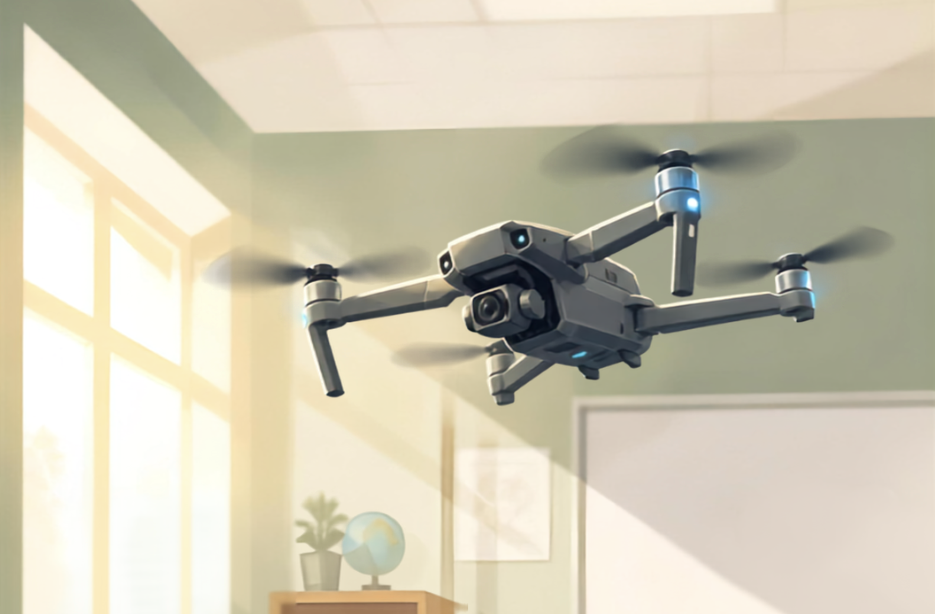
Remotely operated, force-capable indoor drones are now being proposed for use in occupied K–12 schools. Public descriptions include aircraft that can provide live video and audio, issue commands, activate bright lights and sirens, create explosive-sounding distractions, deploy pepper-based projectiles, and intentionally strike a person identified as an attacker.
That makes this far more than a discussion about whether a drone can fly through a hallway.
It is a question of whether an entire remotely operated system can function safely and reliably inside a real school—through locked doors, protected windows, stairwells, radio dead zones, moving students, incomplete information, communication delays, arriving responders, and rapidly changing conditions.
Once a drone can intentionally spray, strike, or otherwise apply force to a person, it also crosses a major policy and legal line. It is no longer simply a camera or reconnaissance tool. It becomes a remotely operated use-of-force system inside a building occupied by children.
Real Schools Are Not Indoor Flight Courses
Schools are among the most complex occupied facilities in a community.
A single campus may include buildings constructed in different decades, later additions, portable classrooms, narrow corridors, stairwells, elevators, gyms, auditoriums, kitchens, laboratories, shops, swimming pools, mechanical spaces, storage areas, and rooms that have changed purpose many times.
Schools also contain the barriers intended to protect people:
- closed, locked, and latched classroom doors;
- fire-rated corridor and stairwell doors;
- fixed, laminated, filmed, or hurricane-resistant glazing;
- secured vestibules and controlled exterior entrances;
- smoke barriers and compartmentation;
- protected or windowless interior rooms.
Those features are not inconveniences to be engineered around casually. They support lockdown, fire protection, smoke control, privacy, accessibility, forced-entry resistance, and safe egress.
Michael S. Dorn, drawing on his work connected to the Marjory Stoneman Douglas High School shooting, points to a basic building reality. Hurricane-resistant glazing would not have provided an easy exterior entry route for a drone, and closed fire doors at the ends of the hallways would have restricted movement between areas.
His point is larger than one campus.
The same doors and glazing that may stop a drone may also be protecting the people behind them.
Lockdown procedures generally tell students and employees to close and lock doors, remain out of sight, and avoid opening a door until identity and authority have been verified. A drone generally cannot enter a closed, windowless classroom without an opening or someone exposing themselves to open the door.
A school should not be expected to weaken a protective opening, modify a fire-rated assembly, create an unreviewed “drone door,” or ask occupants to open a secured room during an attack.
The technology must prove that it can operate within the school’s safety, security, fire-code, accessibility, and egress requirements—not require the school to be redesigned around the technology.
A Real Attack Changes the Entire Environment
A controlled demonstration may include known routes, prepared buildings, charged batteries, functioning cameras, working networks, cooperative role players, and operators who know what is expected to occur.
A real school attack may include fire alarms, conflicting emergency announcements, smoke, sprinkler water, darkness, debris, broken glass, locked or damaged doors, injured occupants, abandoned weapons, students moving in different directions, and multiple responders entering from separate locations.
Radio traffic may be congested. The internet connection may degrade. Maps may be outdated. Cameras may not cover the critical area. Power may fail. Information reaching dispatch, school leadership, police, and the remote operator may be incomplete or contradictory.
The investigations of Parkland and Uvalde demonstrate how quickly movement, notification failures, access problems, radio limitations, inaccurate information, and command challenges can overlap during a school attack. Those conditions are not unusual technical edge cases. They are part of the environment in which any proposed response system must be expected to perform.
A successful demonstration proves that a prepared sequence is possible.
It does not prove that the complete mission will work safely and reliably during actual chaos.
The System Must Do Much More Than Fly
The aircraft is only one component.
The complete mission begins when an alert is generated and continues through verification, launch, navigation, communication, identification, legal authorization, force delivery, responder coordination, medical response, evidence preservation, and after-action review.
The system must receive the correct alert, identify the correct building and location, launch the correct aircraft, maintain secure video and control links, navigate the actual campus, find the right person, distinguish that individual from every other armed or moving person, obtain lawful authority, apply force accurately, avoid bystanders, and stop immediately when the situation changes.
Failure at any point may not simply mean that the drone does not complete its mission.
It may create false confidence, delay another response, crash into an occupied area, obstruct an evacuation route, contaminate students or responders, confuse police, or direct force toward the wrong person.
As of NCSSD’s July 15, 2026 review, publicly available information did not identify an actual K–12 active shooter incident in which a force-capable indoor drone located and incapacitated an attacker. That is fortunate, but it means current claims of effectiveness remain based on demonstrations, modeling, component performance, and anticipated outcomes—not actual K–12 incident results.
Lag Can Turn Current Information Into Past Information
Latency is not simply a technical inconvenience when force may be applied.
End-to-end delay includes the time required for the camera to capture an image, transmit it through the school and remote network, display it to the operator, allow a decision to be made, send the command back to the aircraft, and execute that command.
During that time, a person may move, drop a weapon, be disarmed, enter a room, fall, or be approached by a student or responding officer.
A person shown holding a firearm on the operator’s screen may no longer be holding it when the drone acts.
A student or officer may enter the area after the decision is made but before the command is completed.
The system must therefore demonstrate worst-case latency—not merely an average under ideal conditions. The operator and authorizing official should be able to see continuously how old the image is, and the force capability should automatically lock out when video is frozen, delayed, degraded, or uncertain.
Detecting a Weapon Is Not the Same As Identifying An Attacker
A person holding or standing near a firearm could be the attacker. That person could also be:
- a school resource officer;
- a responding patrol officer;
- a plainclothes detective;
- an authorized armed employee;
- a civilian who disarmed the attacker;
- an injured person near a dropped weapon;
- someone attempting to secure or move the weapon.
The camera may not show what happened seconds earlier. It may not show another person outside the frame. Motion blur, smoke, low light, video compression, vibration, glare, sprinkler water, furniture, backpacks, and moving crowds may further limit what the operator can see.
Human control is preferable to autonomous force. But placing a human in the decision loop does not create information the camera failed to capture.
Districts and policymakers must also know whether object detection, automated tracking, facial recognition, artificial-intelligence recommendations, or predictive tools influence whom the system follows and what information is presented to the operator.
A narrow camera view can conceal a child or responder. A stale map can send the aircraft to the wrong room. A targeting error can turn a proposed safety measure into an additional source of harm.
Legal Authority Must Come Before Technical Capability
The ability of a technology to apply force does not create the legal authority to use it.
A demonstration, grant, appropriation, contract, donation, or school-board vote does not by itself determine who may identify a person as the threat, what legal standard applies, or who bears responsibility when the decision is wrong.
Before any operational deployment, a district would need written, jurisdiction-specific answers to fundamental questions:
Who verifies that an actual attack is occurring? Who designates the person as the threat? Who selects the level of force? Who sends or approves the command? Can a private contractor act before sworn law enforcement arrives? What happens when the remote operator and responding officers disagree? Who has immediate abort authority? When does authority transfer, and how is that transfer communicated?
A general promise to “coordinate with law enforcement” is not a command protocol.
The NCSSD research recommends that no private contractor independently authorize force. Any such decision should be made under clear, written, publicly accountable sworn law enforcement authority, with positive confirmation and automatic disengagement when identity, video integrity, communications, location, or authority is uncertain.
Use of Force Must Still Be Independently Justified
The legal standard cannot become:
The system identified the person, so the force was justified.
Technology does not determine legality.
Any application of force would still have to be evaluated according to the facts known at that moment, the immediacy of the threat, the reliability of the information, the proportionality of the action, and the legal authority of the decision-maker.
That analysis becomes especially difficult when video is delayed or incomplete, a weapon has been dropped or transferred, responders have entered the area, or the person shown is an officer, armed employee, civilian defender, or injured victim.
The legal analysis may extend across aviation and weapons laws, state use-of-force requirements, private-security licensing, constitutional protections, disability law, student rights, privacy, public records, building and fire codes, evidence handling, cybersecurity, procurement, insurance, and governmental liability.
The NCSSD research specifically calls for written legal review of aviation, weapons, law enforcement, private security, civil rights, disability, privacy, records, procurement, liability, and labor issues before an occupied-school force capability is authorized.
Federal and State Law Cannot Be Assumed Away
The FAA has stated that operating a drone with a dangerous weapon attached violates federal restrictions unless specific authorization is obtained. Indoor operation may raise different aviation questions, but a district should not assume that being inside a building eliminates federal weapons concerns, state use-of-force laws, private-security requirements, tort liability, or other legal obligations.
State approaches also differ.
Texas law addressing law enforcement use of force by drone emphasizes a written agency policy, independent justification for the underlying use of force, and the relationship between the person acting and the law enforcement agency. Louisiana has authorized a limited state pilot framework, but the existence of a pilot law does not automatically resolve local force authority, medical standards, insurance, liability, data governance, or implementation questions.
A state appropriation authorizes spending. It does not prove effectiveness, create universal legal authority, or remove the need for jurisdiction-specific review.
Civil Rights and Disability Considerations Are Central
A person may fail to comply with a drone-issued command for many reasons unrelated to hostile intent.
The person may be deaf or hard of hearing, unable to understand the language used, autistic, cognitively disabled, physically injured, experiencing a trauma freeze response, unable to see because of smoke, or uncertain whether the drone is controlled by police or by the attacker.
Treating noncompliance as evidence of dangerous intent could implicate constitutional protections, disability law, language access, due process, equal protection, and student-rights requirements.
Students also attend school within a compulsory-education environment. They cannot meaningfully choose whether to enter a privately operated force system.
That makes independent civil-rights, disability-access, and public-policy review essential—not optional.
"Less-Lethal" Does Not Mean Harmless
Chemical irritants used inside an occupied school may cause burning eyes, impaired vision, coughing, wheezing, breathing difficulty, panic, and contamination of uninvolved students, employees, police officers, firefighters, and medical personnel.
Projectiles and deliberate high-speed impacts create different risks, including eye, facial, head, spinal, orthopedic, and fall injuries.
A drone can miss, ricochet, rebound, crash, break apart, or strike another person. An individual affected by chemicals or impact may fall onto stairs, glass, furniture, another person, or a weapon.
The exact chemical agent, projectile construction, velocity, pressure, impact energy, target area, and exclusion zone must be independently evaluated. Medical and decontamination plans must address children, asthma, respiratory conditions, disabilities, HVAC distribution, responder exposure, transport, evidence collection, and reoccupancy of the building.
Data and Evidence Cannot Remain Solely in Vendor Control
A single activation could generate school camera footage, drone video, audio, operator communications, alerts, maps, location data, access-control records, telemetry, force commands, 911 recordings, and law enforcement radio traffic.
Policies and contracts must establish who owns each record, who may access it, how long it is retained, how original files and metadata are preserved, and how parents, investigators, defendants, courts, and public-records officials may obtain it.
A district cannot allow the company whose performance or conduct is being investigated to possess the only complete record of what occurred.
The contract must also address what happens if the vendor is acquired, becomes insolvent, loses insurance, cannot staff its operations center, or discontinues the system. The district should retain its maps, configurations, evidence, and audit logs in usable formats.
Liability Extends Beyond a Mistaken Strike
Potential legal exposure may arise from mistaken identification, excessive or unauthorized force, chemical exposure, projectile injury, a drone crash, interference with police or fire operations, negligent operator training, cybersecurity compromise, inaccurate maps, stale video, loss of evidence, inadequate medical planning, or building modifications that compromise code compliance.
Districts should not assume that vendor indemnification transfers the risk.
Counsel and insurers would need to examine use of force, bodily injury, civil-rights claims, aviation, chemical agents, cybersecurity, privacy, professional services, product defects, premises liability, workers’ compensation, evidence preservation, contractual caps, and exclusions.
Indemnification is only meaningful if the vendor has the insurance, financial capacity, and contractual obligation to honor it.
Every force activation, injury, mistaken identification, cyber event, lost-control incident, or serious near miss should trigger independent investigation and public after-action review, subject to lawful protections.
Operational Cost Can Also Become a Legal and Governance Concern
The cost of a force-capable drone system is not limited to its advertised purchase or service price.
The complete cost may include electrical work, network improvements, launch equipment, cameras, digital mapping, radio coverage, access-control integration, backup power, cybersecurity, legal review, insurance, training, batteries, replacement aircraft, medical planning, independent testing, maintenance, recurring service charges, and eventual removal.
NCSSD recommends a binding, campus-specific ten-year total-cost analysis.
That investment must also be compared with what the school could provide instead.
Depending on enrollment, configuration, local compensation, benefits, and law enforcement cost sharing, the cost could rival or exceed what a district spends for a trained security professional or contribute substantially toward an SRO, school safety coordinator, mental-health support, threat-assessment capacity, or a combination of foundational improvements.
This is not an argument that every school must employ an SRO. It is an argument that meaningful alternatives must be compared.
A qualified on-site professional may contribute to prevention, relationship-building, threat assessment, de-escalation, visitor management, traffic and pedestrian safety, medical events, missing students, emergency planning, drills, communication, and coordination with police, fire, EMS, families, and community resources.
The drone is proposed primarily for one rare catastrophic scenario. A trained person may serve the school throughout every day of the year.
A major expenditure may also become relevant in later litigation if a district invests heavily in a narrow, unvalidated capability while known and more foreseeable hazards remain unresolved. The issue would not simply be what the district purchased. It would be whether the decision followed a documented all-hazards assessment, compared reasonable alternatives, addressed known deficiencies, and represented a defensible use of limited safety resources.
Legal exposure may arise not only from what the system does, but also from what the district chose not to address because it funded the system.
Foundations Empower Schools Every Day
Reliable doors, access control, communications, responder access, emergency power, mapping, prevention, threat assessment, training, and student support are not dormant security measures waiting for an attacker.
They allow a school to function safely every day.
They support controlled entry, normal movement, supervision, visitor management, arrival and dismissal, after-hours activities, medical response, severe-weather sheltering, fire evacuation, family reunification, behavioral intervention, emergency communication, and continuity of operations.
They also give employees the information, tools, and confidence needed to make decisions across many hazards.
A force-capable drone system depends on those foundations already working. It assumes accurate maps, reliable doors, functioning cameras, low-latency networks, interoperable radios, tested emergency power, and established multiagency command.
No district should be asked to trade the people and systems that empower a school to operate safely every day for an unproven remote-force capability intended primarily for a rare catastrophic event.
The question is not only what a technology might do on the school’s worst day.
It is whether investing in it strengthens—or weakens—the school’s ability to function safely on every other day.
A Responsible Position Is Not Anti-Drone
Non-weaponized drones can provide valuable public-safety capabilities, including outdoor perimeter awareness, search and rescue, missing-person searches, disaster assessment, evacuation-route monitoring, reunification support, hazardous-material reconnaissance, and post-incident documentation.
Force-capable indoor drones are a different technology and governance category.
NCSSD does not oppose responsible research. But research should begin in controlled facilities, proceed to unoccupied representative schools, include independently designed failure scenarios, and publish data on failed launches, lost links, crashes, inaccessible rooms, false identifications, aborted force decisions, injuries, and near misses—not only successful demonstrations.
An occupied school should not become an ordinary technology beta-test environment.
The responsible path is disciplined sequencing:
Secure and verify the foundations. Separate reconnaissance from force. Test the full mission independently. Publish successes and failures. Place any force decision under clear sworn public authority. Protect students, responders, civil rights, data, and evidence. Compare the investment with people and systems that serve the school every day. Stop deployment whenever uncertainty exceeds a defined safety threshold.
Innovation in school safety must reduce total risk—not merely add a dramatic capability.
This article was contributed by Guy Grace, who served as the director of Security and Emergency Planning for Littleton Public Schools in Denver, Colorado, for more than 30 years. He currently serves as K-12 National Security Program Manager for ASSA ABLOY.
Note: The views expressed by guest contributors are those of the authors and do not necessarily represent the views of, and should not be attributed to, School Security Leadership.