New NCSSD Resource Examines Force-Capable Indoor Drones in K-12 Schools
As force-capable drones gain attention in school safety discussions, this new NCSSD resource examines the operational, legal, funding, and policy questions school leaders and policymakers should consider before deployment.

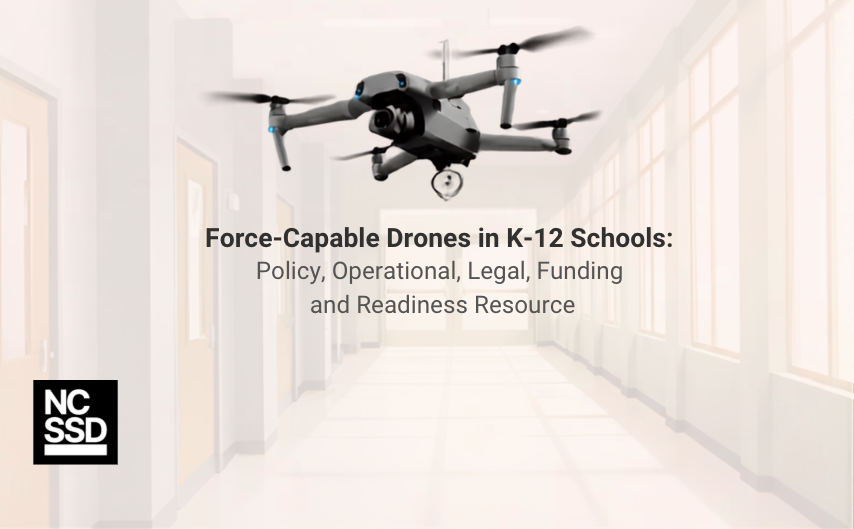
As lawmakers, school districts, and technology companies explore the use of force-capable indoor drones as part of school safety strategies, the National Council of School Safety Directors (NCSSD) has released a new public resource examining the operational, legal, medical, funding, and policy questions surrounding the technology.
The 30-page resource was developed by the NCSSD Government Relations Committee to help school leaders, policymakers, public safety agencies, and other stakeholders evaluate these systems beyond product demonstrations and marketing claims. Rather than focusing on whether drones can fly inside buildings, the guide examines the broader question of whether remotely operated systems capable of applying force inside occupied schools have been sufficiently validated for real-world deployment.
Importantly, the resource distinguishes between two very different uses of drone technology. It recognizes that non-weaponized drones can provide valuable capabilities for public safety missions such as perimeter surveillance during emergencies, search and rescue, disaster assessment, hazardous materials response, and other emergency operations when used under appropriate policies and safeguards. However, the resource finds that indoor drones capable of deploying chemical irritants, projectiles, or other forms of force represent a fundamentally different category of technology—one that requires a substantially higher level of independent validation, governance, testing, and public accountability before being deployed in occupied schools.
Rather than advocating for or against any specific vendor or product, the resource encourages school leaders to evaluate proposed systems within the realities of K-12 environments. Among the issues explored are:
- Building design
- Communications
- Emergency response
- Use-of-force authority
- Cybersecurity
- Medical considerations
- Civil rights
- Liability
- Long-term funding
- Opportunity costs associated with investing in emerging technologies
The report also includes a foundation-first readiness checklist, failure-mode analysis, policy recommendations, and more than three dozen supporting references.
The report emphasizes that successful demonstrations should not be viewed as proof that a technology can reliably perform during an actual school emergency. According to the resource, any proposed system should be evaluated not only on whether it can function under ideal conditions, but whether it can operate safely and effectively amid the uncertainty, building constraints, and rapidly changing conditions that characterize real incidents.
Ultimately, the guide recommends that schools prioritize foundational safety capabilities—including access control, communications, emergency planning, responder coordination, and threat assessment—before considering technologies intended primarily for rare catastrophic events. It also calls for independent validation, transparent testing, and clear public accountability before force-capable indoor drones are operationally deployed in occupied schools.
The complete resource is available below and may be distributed in its entirety with attribution. Readers looking for a concise overview of the research may also find NCSSD's companion Media Guide & Talking Points helpful.