AI Police Scanner Alerts Can Create Communication Challenges for Schools
School safety leaders discuss AI scanner misinformation, family communication, and crisis preparedness.

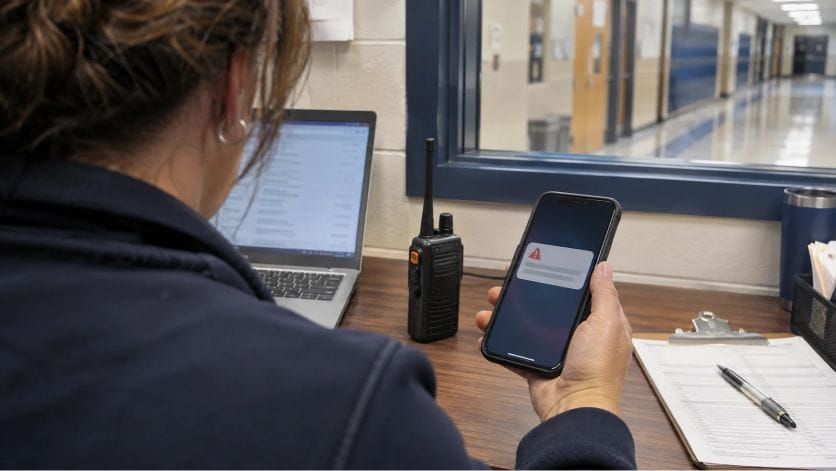
An inaccurate alert from an AI-powered police scanner app prompted calls and unexpected parent arrivals at an elementary school, according to a school safety director who shared the incident during a National Council of School Safety Directors (NCSSD) roundtable.
The director said the app combined unrelated radio transmissions into a report suggesting an armed suspect at the school, where staff were responding to a student incident.
His account prompted a broader discussion about correcting misinformation, coordinating with public safety partners, and keeping families informed during emergencies.
More Insights From School Safety Leaders
Explore NCSSD roundtable recaps for experiences, perspectives, and approaches shared by school safety professionals.
Browse Roundtable Recaps →Tracing an Alert Back to Its Source
The director said the situation began with an officer requesting administrative information about a student incident at the school. In the next radio transmission, a different officer at an unrelated scene reported that someone was in custody.
According to the director, the app combined information from the transmissions into an inaccurate alert. Parents began contacting the school with concerns about a shooting nearby, and some arrived to pick up their children. Staff had to manage the calls and unexpected arrivals while responding to the original incident.
Identifying the source took approximately 30 minutes, the director said. The version shared with school staff referred to dispatch audio but did not clearly identify the app. Staff could not find the report through a Google search and needed a direct link to trace its source.
The director identified the app as Crime Radar and said its headline was later changed. His explanation of the error was based on reviewing the dispatch recording and the alert.
How AI Turns Radio Traffic Into Alerts
Apps that summarize scanner traffic can make public safety communications accessible to people who would not otherwise listen to police radio.
For example, the CrimeRadar app listing describes using AI to summarize and map potential incidents drawn from first-responder audio, with notifications based on dispatch activity.
For school staff, an inaccurate alert can create a second set of demands during an incident. Alongside responding to the original situation, they may need to trace the alert’s source, determine what families are seeing, and correct misinformation.
Coordinate With Public Safety Partners Before an Incident
The director encouraged school safety leaders to discuss radio communications with local law enforcement and dispatch personnel before a sensitive school incident occurs. Those conversations can establish which channels are publicly accessible, what information officers and dispatchers typically share, and whether nonurgent administrative requests can be handled by phone or mobile data terminal when appropriate.
He emphasized that school districts do not control police radio systems or what officers broadcast. Coordination therefore depends on understanding public safety partners’ responsibilities and maintaining relationships that allow concerns to be addressed.
Following the incident, he said he met with law enforcement partners to discuss how communications had been handled.
He also encouraged districts and law enforcement agencies to discuss their public messaging practices. A school’s statement may contain fewer details than a police release, particularly when students are involved. Discussing those differences beforehand can help agencies anticipate questions about why their messages differ.
Establish Who Can Answer Families’ Questions
The discussion then broadened to how school safety leaders communicate with families during emergencies, including who can respond directly and how those responses align with district messaging.
The director said his response to one parent after the app alert explained why the information was inaccurate and reinforced that students were safe. He kept the response consistent with the school system’s message.
He encouraged safety leaders to establish internal expectations for those exchanges. Questions include whether the superintendent supports direct responses, which information can be shared without additional approval, and when the public information officer should be involved.
NCSSD President Guy Bliesner emphasized that a personal response can reinforce information already included in a general statement without introducing new details. He cautioned that leaving an inquiry unanswered can lead a parent to believe school officials are unwilling to talk or are withholding information.
Responding individually and communicating more broadly can serve different purposes, he said. A direct exchange can address a family’s concern, while a general update can make relevant information available to the wider community.
One participant said she meets with parents, preferably alongside the principal, to hear their concerns and answer questions using information the district has already released. She refers to the district’s letter and explains safety procedures, providing reassurance without disclosing additional details.
Tell Families When to Expect the Next Update
Another participant encouraged school leaders to timestamp public statements and specify when the next update will be provided. Rather than promising more information when it becomes available, he suggested giving families and reporters a specific time. If there is nothing new to report at that point, officials can acknowledge that work is continuing and establish another update time.
He said this approach demonstrates that officials remain engaged and recognize families’ and reporters’ need for timely information. He also encouraged professional media training and ongoing relationships with local news organizations. Schools that want reporters to cover their accomplishments need to be available during difficult situations as well, he said.
The director who described the inaccurate alert emphasized that crisis communication should be practiced before a crisis. Regular coordination with district leaders and public safety partners helps establish who can respond, what they can share, and how families will receive accurate information during an incident.