NCSSD Member Spotlight: Kalim Ansari of Green Dot Public Schools
Green Dot Public Schools Security Coordinator Kalim Ansari shares his approach to preparedness, operational safety assessments, and continuous improvement in school safety.

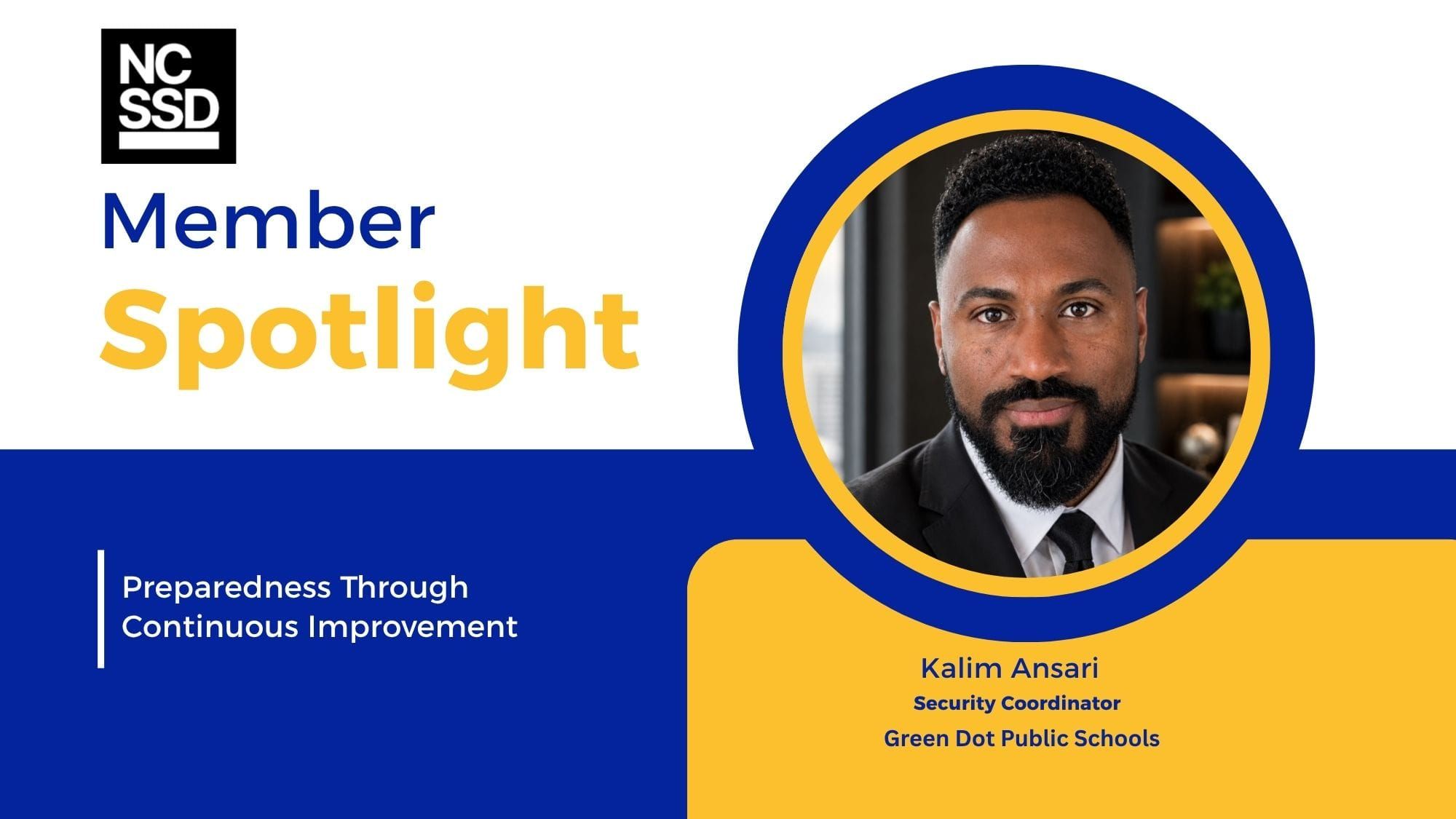
Kalim Ansari has spent more than a decade working in school safety and security, with experience spanning operational safety, emergency preparedness, crisis management, physical security, incident response, and risk mitigation.
As Security Coordinator for Green Dot Public Schools, Ansari supports safety and security strategy across a multi-site portfolio in the Los Angeles area. He works with school leaders, cross-functional teams, contracted security professionals, and public-safety agencies.
His path into school safety leadership began in a supporting role that put him directly alongside students.
“My early experience included morning arrival, breakfast supervision, and transporting students to and from locations outside normal school boundaries and jurisdictions,” Ansari said. “Because I was serving a school community for students with disabilities and special needs, those responsibilities taught me early that safety begins with understanding the people you are responsible for, their individual needs, and the environment around them.”
As his career progressed, Ansari moved into a different school community and had to learn its environment and culture.
“Spending years serving within that same community helped me understand its challenges, build relationships, and see firsthand how safety influences everything else a school is trying to accomplish,” he said. “Over time, my focus evolved from responding to individual security concerns to thinking more strategically about preparedness, risk, systems, and organizational resilience.”
Learn the Environment Before Trying to Change It
Working across multiple school communities has shaped Ansari’s leadership approach.
“I learned quickly that there is rarely a one-size-fits-all solution to school safety,” he said. “Every campus has different people, environments, vulnerabilities, and operational realities.”
That experience taught him to listen first, assess the actual risk, involve the people closest to the issue, and develop solutions that are both effective and sustainable.
It is also the basis of his advice for those entering school safety leadership.
“Learn the environment before trying to change it,” Ansari said. “Spend time with school leaders, teachers, operations teams, students, security personnel, and public-safety partners. Understand how the school actually functions, not just what the written plan says. Then assess risk and build from there.”
“The strongest safety programs are not built around fear or a single product,” he added. “They are built around relationships, preparedness, clear systems, and continuous improvement.”
Keeping Preparedness Programs From Becoming Static
One initiative Ansari is especially proud of is helping develop and sustain Green Dot Public Schools’ active-assailant preparedness program.
“We recognized that employees needed more than written emergency procedures. They needed a framework for making informed decisions during a rapidly evolving violent critical incident,” he said.
The organization implemented a layered approach combining foundational learning with instructor-led Safe Skill Scenarios that allow participants to apply those concepts in a controlled environment.
As the program matured, Ansari said the organization also recognized the risk of training complacency.
“We began evolving scenarios to challenge participants to listen, process changing information, and make decisions rather than simply anticipate a familiar drill,” he said.
After nearly a decade of implementation, one lesson has stood out.
“Preparedness programs cannot become static,” Ansari said. “They have to be continually evaluated, challenged, and improved.”
Creating Consistency Across Multiple Campuses
One of Ansari’s current priorities is strengthening consistency across a multi-site organization while recognizing that each school has its own operational realities.
He is focused on expanding Green Dot’s Operational Safety Assessment process, strengthening emergency preparedness and student-inclusive exercises, and helping school leaders translate identified risks into practical improvements.
“The challenge is balancing multiple safety priorities without creating initiative fatigue,” Ansari said. “My approach is to prioritize risk, establish realistic timelines, and focus on sustainable improvements rather than trying to solve everything at once.”
Green Dot has moved toward standardized frameworks for assessments, emergency preparedness, training, and follow-up while still allowing site-specific risks to inform recommendations.
That approach, Ansari said, “creates a common organizational baseline without assuming every campus requires the same solution.”
“My advice to another district would be to standardize the process, not necessarily every outcome,” he said. “Establish clear expectations and assessment criteria, involve site leadership, document what you find, prioritize by risk, and build accountability for follow-through.”
Structured Operational Safety Assessments are one part of that process.
“Rather than waiting for an incident to reveal a vulnerability, the assessment creates an opportunity to walk the environment, observe actual operations, speak with site leaders, evaluate existing safeguards, and identify gaps before they contribute to an incident,” Ansari said.
The process also recognizes what a school is already doing well and prioritizes recommendations based on risk rather than producing what Ansari described as “an unrealistic list of deficiencies.”
“I believe other school safety leaders can benefit from making assessments a continuous improvement process, not an inspection designed to assign blame, but a collaborative tool for strengthening operational readiness,” he said.
School Safety as a System
Ansari said one thing he wishes more educators, administrators, and community members understood is that school safety is not the responsibility of a single person or department.
“School safety is not a single department, person, product, or security measure. It is a system,” he said. “Cameras, access control, security personnel, emergency plans, training, student supports, communication, and strong relationships all have value, but none of them operates effectively in isolation.”
“School safety leadership is about understanding how those pieces work together, identifying where gaps exist, and building shared responsibility across the organization,” he continued.
“The goal should never be to make a school feel like a fortress. It should be to create an environment where safety is intentionally built into everyday operations while preserving the welcoming culture students and families deserve.”
Strengthening Parent and Family Engagement
Over the next year, Ansari is especially interested in strengthening parent and family engagement around school safety.
“Parents entrust schools with what is most important to them, their children, and I believe we have a responsibility not only to build strong safety and security practices, but also to help families understand those practices, ask questions, and have meaningful opportunities to participate in the conversation,” he said.
Ansari was recently reminded of that while presenting Green Dot’s active-assailant preparedness and ALICE training approach to a group of parents.
“What stood out to me was not only their appreciation for the information, but their desire to continue the conversation and have more time to ask questions,” he said.
For Ansari, the experience reinforced the role parent engagement can play in a comprehensive school safety strategy.
“When families understand why we train, how we prepare, and how seriously their children's safety is taken, it can strengthen both preparedness and trust between the school and the community,” he said.
Connecting With Other School Safety Leaders Through NCSSD
Ansari joined NCSSD to connect with professionals who understand the responsibilities of leading safety in educational environments. He has also completed NCSSD’s Foundations of School Security Leadership (FoSSL) program.
“School safety can be an incredibly broad discipline, and there is tremendous value in learning from people who are facing many of the same challenges in different communities across the country,” he said.
Ansari said FoSSL provided structured professional development while exposing him to different perspectives and approaches.
“The greatest value has been knowing there is a professional community where practitioners can learn from one another, share experiences, and continue raising the standard of school safety leadership,” he said.
Asked what he would tell someone considering joining NCSSD, Ansari’s answer was simple: “Do it and don’t second-guess your decision.”
He also pointed to NCSSD’s monthly meetings as a benefit of membership, saying they provide opportunities for members to stay connected and check in throughout the school year.
For Ansari, continuing to learn from other practitioners is part of an ongoing process.
“If there is one thing my career has reinforced for me, it is that school safety is never finished,” he said. “There will always be another risk to assess, another lesson to learn, another relationship to build, and another opportunity to improve.”
“None of us will ever have every answer, but we can make the profession stronger by continuing to learn from one another.”
Connect With Kalim and Other School Safety Leaders
Join NCSSD to connect with Kalim and other school safety professionals from across the country, access resources and professional development, and participate in member discussions and events.
NCSSD also offers membership scholarships to eligible school safety professionals. Learn more about the NCSSD Scholarship Program.