Behavioral Threat Assessment Interviews: Strategies for Gathering Better Information
Drawing on nearly three decades of experience, one practitioner shares what he has learned about conducting thoughtful, effective behavioral threat assessment interviews.
"The quality of a threat assessment depends on the quality of the information gathered. The quality of the information gathered depends on the quality of the conversation."
Every behavioral threat assessment begins with information.
A teacher overhears a troubling comment. A student reports concerning activity on social media. A parent discovers alarming messages on a phone. A coach notices a significant change in behavior. An administrator receives information that simply doesn't feel right.
Regardless of how the concern reaches the multidisciplinary threat assessment team, the next step is almost always the same: gather information before making decisions.
As practitioners, we spend considerable time discussing what information should be collected. We review warning behaviors, examine digital activity, interview witnesses, analyze school records, and consider stressors, protective factors, and the broader context surrounding the concern. Those conversations matter because good decisions depend on complete and accurate information.
What receives far less attention is how we gather that information.
Looking back over nearly three decades in public service, including eight years as a School Resource Officer (SRO), years serving in school safety leadership, and working in behavioral threat assessment and management, I've come to believe that the interview is much more than another step in the assessment process.
Early in my career, I believed successful interviews depended on asking the right questions. Experience eventually taught me something different.
The quality of the conversation often determines the quality of the information we receive.
And the quality of the information we receive often determines the quality of the decisions that follow.
Over the years, I also came to realize that the purpose of a behavioral threat assessment interview is not to obtain a confession, prove someone is lying, or decide whether a student poses a danger. Those decisions, when appropriate, come later as the multidisciplinary team evaluates all available information.
The interview serves a different purpose.
It is an opportunity to gather reliable information that helps us better understand the student's behavior, thinking, circumstances, and current level of concern. Every meaningful conversation reduces uncertainty and gives the multidisciplinary team a stronger foundation for making thoughtful, defensible decisions.
The Behavioral Threat Assessment Interview Begins Before the First Question
One of the biggest surprises early in my career was realizing that interviews rarely begin with the first question.
By the time a student walks into the room, the conversation has already started.
Students notice everything.
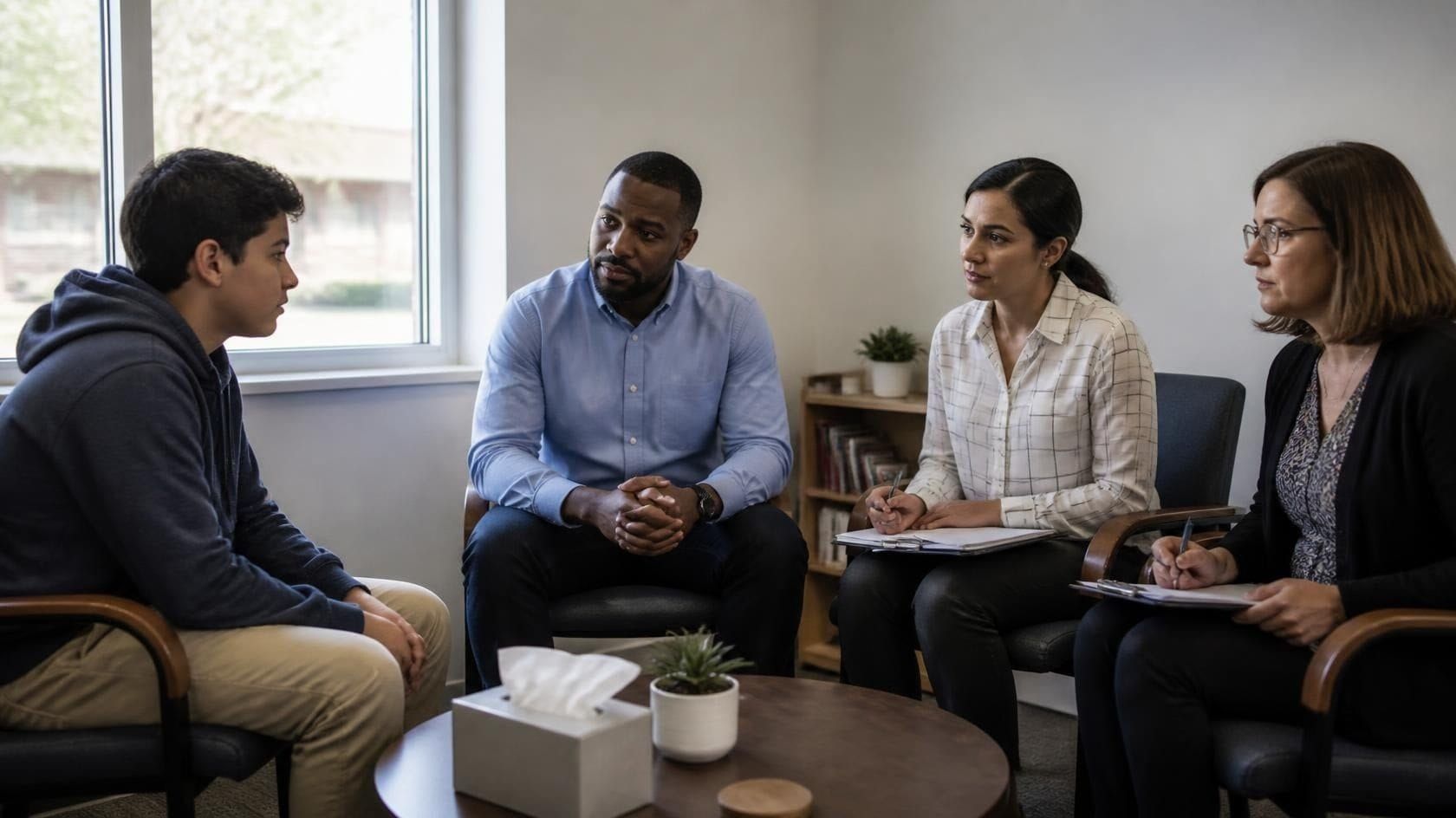
They notice who is in the room. They notice where people are sitting. They notice who has the notebook, who asks the first question, and whether the atmosphere feels calm or tense. Before we begin assessing them, they have already begun assessing us.
Most students have never participated in a behavioral threat assessment interview. Many have no idea what to expect. Some assume they are already in trouble. Others believe everyone has already decided what happened before they've had the opportunity to explain their perspective.
I've found that spending just a minute or two explaining the purpose of the interview can completely change the tone of the conversation.
A simple statement like, "I wasn't there, so I need your help understanding what happened," communicates something important. It tells the student their perspective matters. It doesn't promise a particular outcome. It doesn't remove accountability. It simply communicates that understanding comes before evaluation.
Looking back, I wish I had learned that lesson much earlier in my career.
Avoid Reaching Conclusions Too Soon
One lesson experience has reinforced time and again is the importance of resisting early conclusions.
By the time a student is referred for a behavioral threat assessment, teachers, administrators, parents, and sometimes law enforcement have already discussed the situation. Reports have been written. Statements have been gathered. Initial impressions have naturally begun to form. That information is valuable because it provides context. It also carries risk.
If we're not careful, those early impressions can introduce confirmation bias, our natural tendency to give greater weight to information that supports what we already believe while overlooking information that points in another direction. I've learned that this bias isn't intentional. It's simply human nature.
Once we develop an early theory about what happened, it's easy to interpret new information through that lens rather than allowing it to reshape our understanding. That's exactly when I remind myself to slow down.
Over time, I realized my job wasn't to decide whether the initial report was right or wrong. My job was to leave the interview with a better understanding than I had when I walked in. Sometimes that understanding reinforced the team's initial concerns. Other times it challenged our assumptions or revealed circumstances no one knew about.
Either way, the assessment was stronger because it was based on a more complete understanding of the student's behavior, thinking, and circumstances, rather than solely on the information available before the interview. Before every interview, I ask myself one simple question.
"What information might change my current understanding of this situation?"
That question reminds me to stay curious. I've found that the best interviews rarely tell me what I already know. They help me discover what I didn't know before the conversation began.
Rapport Is Professional, Not Personal
Another lesson took me years to fully appreciate.
Rapport is one of the most misunderstood aspects of interviewing. Some people equate it with being friendly or trying to make a student like you. Others believe building rapport means lowering expectations or avoiding difficult conversations.
I've found neither to be true.
Professional rapport is built on fairness, respect, honesty, and transparency. Students are more likely to share meaningful information when they believe they are being treated fairly, even when the conversation is uncomfortable. Fairness doesn't mean agreement, and respect doesn't mean eliminating accountability. It simply means giving someone the opportunity to explain their perspective before decisions are made.
One principle from Verbal Judo has stayed with me throughout my career.
Respond. Don't react.
When emotions rise, the interviewer's response often determines where the conversation goes next. I've learned that statements like, "Help me understand," or, "Walk me through what you were thinking," almost always lead to a more productive conversation than arguing about intent or trying to convince someone they're wrong. The goal isn't to win the conversation. The goal is to understand the student well enough that the multidisciplinary team can make the most informed decision possible.
Let the Student Tell the Story
If there is one interviewing habit that has improved my assessments more than any other, it is learning to talk less. Early in my career, I measured a good interview by the number of questions I asked. Today, I measure it by the quality of the information the student volunteers before I begin asking follow-up questions.
That's often where the most valuable information is found. I almost always begin with broad, open-ended invitations.
"Tell me what happened."
"Walk me through it from the beginning."
"Start wherever makes the most sense to you."
Those questions allow students to tell their story in their own words before I begin exploring specific details. Relationships, stressors, misunderstandings, emotions, and motivations often emerge naturally when people are given the opportunity to speak without interruption.
Only after the student's narrative is complete do I begin asking more focused questions to clarify timelines, explore inconsistencies, and compare what I've heard with information gathered from other sources. I've also learned not to become uncomfortable with silence.
Some of the most valuable information I've gathered came several seconds after I thought the student had finished talking. Given enough time, many students continue speaking, clarify earlier statements, or remember details they hadn't initially shared. Sometimes the most important information isn't the answer to a question. Sometimes it's the part of the story we never would have heard if we had interrupted too soon.
Listening Is an Assessment Skill
Listening is often described as a communication skill. I believe it's also an assessment skill.
Behavioral threat assessment depends on understanding behavior within its full context, and listening is one of the primary ways we discover that context. Listening means paying attention to what is said. It also means paying attention to what isn't.
Sometimes students carefully describe everyone else's behavior while avoiding discussion of their own actions. Sometimes they explain events in detail but never describe what they were thinking or feeling. Those omissions shouldn't automatically be viewed as deception. Instead, they become areas for thoughtful follow-up later in the conversation.
I've also become cautious about relying on labels. Words like aggressive, obsessed, manipulative, or withdrawn often reflect someone else's interpretation rather than observable behavior.
Whenever possible, I ask people to describe exactly what they saw or heard instead of the conclusion they reached. Observable behavior is far more useful than subjective labels.
After nearly every interview, I ask myself one question.
"What information did I learn today that I didn't know before the conversation began?" If the answer is very little, my first question isn't about the student. It's whether I created enough opportunity for meaningful disclosure. That reflection has improved my interviewing more than any checklist ever has.
The Last Five Minutes of a Behavioral Threat Assessment Interview Matter
The final few minutes of an interview are often the most overlooked. They're also some of the most important.
Before every interview ends, I summarize what I've heard using the student's own words whenever possible. Then I ask a simple question.
"What did I miss?"
Occasionally, I'll also ask, "Is there anything you thought I was going to ask that I didn't?"
More than once, those questions have produced information that changed the direction of the assessment. They also give students one final opportunity to clarify misunderstandings before the conversation ends. Just as important, I explain what happens next.
Students don't always like the outcome of a behavioral threat assessment, but they should understand the process. Explaining the next steps reduces uncertainty and reinforces that the interview was part of a structured assessment rather than a predetermined decision.
After the student leaves, another interview begins. The one we have with ourselves.
- Did I interrupt too often?
- Did I remain curious?
- Did I listen more than I talked?
- Did I challenge my own assumptions?
- Did I allow the conversation to shape my understanding, or did I allow my assumptions to shape the conversation?
Those questions have probably improved my interviewing more than any formal training course I've attended.
Better Behavioral Threat Assessments Start With Better Information
When I reflect on the interviews that have stayed with me throughout my career, they are rarely the ones where I asked the perfect question. They are the conversations where I listened long enough to hear something I wasn't expecting.
Sometimes it was a family stressor no one knew about. Sometimes a misunderstanding completely changed the direction of the assessment. Sometimes it confirmed exactly what everyone suspected.
Every one of those conversations reinforced the same lesson. The interview isn't where we prove what we think we know. It's where we discover what we don't know yet.
Behavioral threat assessment asks us to make important decisions that affect students, staff, families, and entire school communities. Those decisions deserve more than assumptions. They deserve curiosity, professionalism, disciplined listening, and a genuine commitment to understanding before evaluating.
The interview is not simply another step in the threat assessment process. It is where uncertainty begins to give way to understanding. It is where context replaces assumptions. It is where better information leads to better decisions. Every assessment eventually reaches a conclusion. Long before it does, there is a conversation.
The quality of the assessment depends on the quality of the information gathered, and the quality of the information gathered depends on the quality of the conversation.
Selected References
Calhoun, F. S., & Weston, S. W. (2016). Threat Assessment and Management Strategies (2nd ed.).
Fisher, R. P., & Geiselman, R. E. (1992). Memory-Enhancing Techniques for Investigative Interviewing: The Cognitive Interview.
National Threat Assessment Center. (2021). Averting Targeted School Violence: A U.S. Secret Service Analysis of Plots Against Schools.
Thompson, G. J. (2013). Verbal Judo: The Gentle Art of Persuasion (3rd ed.).
Van der Meer, B. B. (2021). Source interviewing in a threat management context. In J. R. Meloy & J. Hoffmann (Eds.), International handbook of threat assessment (2nd ed., pp. 68–83). Oxford University
Chad Chaney, M.S., CTM, is a behavioral threat assessment and management practitioner with nearly three decades of experience spanning the U.S. Marine Corps, law enforcement, K-12 school safety, and corporate threat management. A U.S. Marine Corps veteran, he has served as a law enforcement supervisor, School Resource Officer, school safety leader, and threat management professional. He holds a master's degree in Criminal Justice and is a Certified Threat Manager (CTM).
Note: The views expressed by guest contributors are those of the authors and do not necessarily represent the views of, and should not be attributed to, School Security Leadership.