What School Security Assessments Reveal About Technology Gaps
Guidepost Solutions' Jordan Ferrantelli shares lessons from assessing school security programs, including common system failures, overlooked risks, and what districts should consider before investing in new technology.

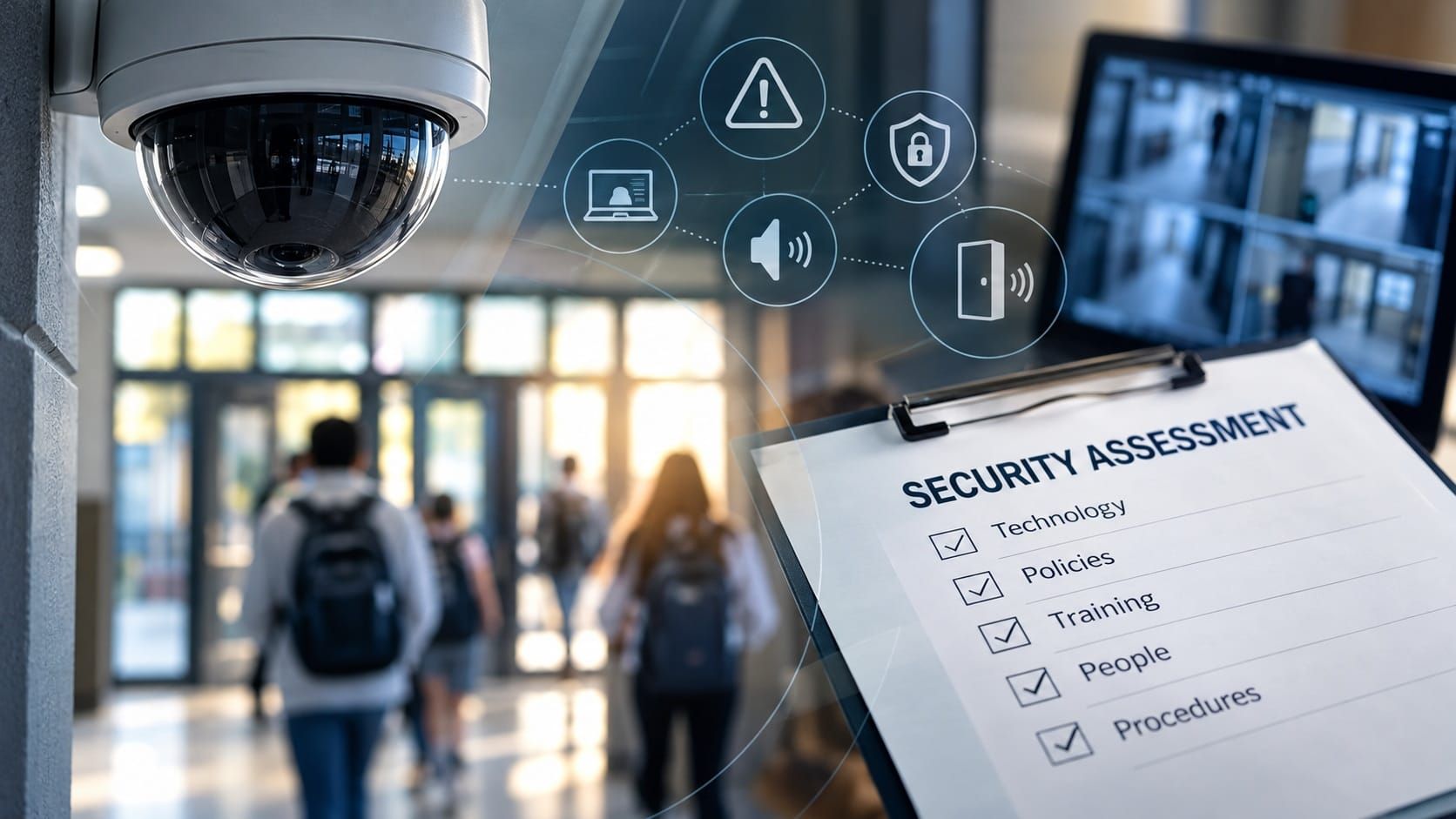
School districts continue to invest in security technologies, from video surveillance and access control systems to AI-powered weapons detection and drones. But purchasing new technology doesn't necessarily mean schools are better prepared to prevent or respond to emergencies.
Guidepost Solutions is a security and risk consulting firm that works with K-12 schools, colleges, and universities on security assessments, planning, technology, and crisis response. The firm has completed more than 2,o00 security design and technology projects and was commissioned by the Oxford Community Schools Board of Education to conduct an independent investigation into the 2021 Oxford High School shooting in Michigan.
School Security Leadership spoke with Jordan Ferrantelli, vice president of Guidepost Solutions' Healthcare, Education & Life Safety Practice, about common gaps in school security programs, the limitations of emerging technologies, and what districts should evaluate before investing in new systems. He also discusses why testing, training, and maintaining existing technology can be just as important as purchasing additional equipment.
Editor's Note: The following Q&A has been lightly edited for length and clarity.
Why does school security technology fall short during emergencies?
One of the most common issues is not that the technology is ineffective, but that the district has not developed the operational framework necessary to support it. We frequently see schools invest heavily in video surveillance, access control, panic alert systems, visitor management platforms, or mass notification technologies without fully defining who monitors them, who responds to alerts, or how those systems integrate into emergency procedures.
Video surveillance is a particularly common example. Districts may have hundreds or even thousands of cameras, but during an assessment we often discover that camera placement does not support critical investigative or response objectives. Operators may not know how to quickly locate footage, and law enforcement may not have practical methods for obtaining video during an incident.
Similarly, access control systems are often underutilized. Schools may have sophisticated software capable of lockdown functions, door schedules, and real-time monitoring, but staff have never practiced using those capabilities during realistic exercises. During an emergency, people default to their training, not the features listed in a product brochure.
The lesson is that technology should never be evaluated based on what it can do. It should be evaluated based on what personnel can reliably and consistently do with it under stress, tested during practice scenarios and updated based on after action reviews.
What problems do schools overlook when implementing security systems?
For example, a district may believe its emergency notification system can instantly notify all stakeholders during a crisis. On paper, that is true. However, when tested, the district may discover that contact lists are outdated, administrators are uncertain who has activation authority, or messages require multiple approval steps before dissemination.
Another common example involves lockdown capabilities. School leaders may believe a single button will instantly secure every building on a campus. In practice, certain doors may not be electronically controlled, some schedules may override security configurations, and staff may not understand what the system actually does when activated.
Video surveillance frequently creates similar misconceptions. Administrators may assume every area of campus is covered and visible when cameras may have blind spots, poor nighttime performance, or bandwidth limitations that affect image quality.
The difference between theoretical capability and operational reality is why testing is so important. A system should not be considered effective because it was successfully installed. It should be considered effective only after it has been demonstrated under realistic conditions.
Related Resource
Video Surveillance in Schools Topic Hub →
Explore articles and resources on school video surveillance, including camera placement, privacy, access to footage, and oversight of surveillance systems.
Which emerging school security technologies need more scrutiny?
I believe any technology receiving significant attention because of fear, urgency, or public pressure deserves additional scrutiny. Currently, that includes AI-powered gun detection, weapons detection systems, drone programs, advanced analytics platforms, and various forms of automated threat identification.
The issue is not that these technologies lack value. Many can provide meaningful benefits when implemented appropriately. The concern is that marketing narratives often advance faster than operational validation.
School leaders should ask several questions before investing:
- What problem are we actually solving?
- What evidence exists that this technology performs effectively in school environments?
- What are its accuracy rates and false-positive rates?
- How much staff involvement is required to monitor and respond to alerts?
- How will it integrate with existing systems and procedures?
- What ongoing operational costs exist?
- What privacy, legal, or community concerns should be considered?
Districts sometimes focus heavily on acquisition costs while overlooking staffing, training, maintenance, software licensing, and program management costs that can exceed the original purchase price over time. Evaluating these long-term costs may reveal that alternative security strategies would be more effective and less expensive.
What warning signs should schools look for when evaluating security technology?
Any claim that sounds too simple for a complex security problem should immediately raise questions.
School leaders should be cautious whenever vendors suggest that specific technology can:
- Virtually eliminate risk.
- Detect every threat with near-perfect accuracy.
- Reduce the need for trained personnel.
- Operate autonomously without oversight.
- Provide immediate response capabilities without process changes.
- Significantly improve safety with little operational investment.
Security is rarely that simple. For example, AI gun detection systems may identify visible weapons, but school leaders should understand environmental limitations, occlusions, image-quality requirements, potential false positives, response workflows, and how alerts are validated before action is taken.
Similarly, drones may offer excellent situational awareness, but districts need to understand FAA requirements, flight restrictions, pilot certification needs, weather limitations, and operational procedures before assuming they provide an immediate solution.
When evaluating emerging technology, school leaders should move beyond demonstrations and ask for evidence from comparable school deployments, after-action reviews, documented case studies, and measurable performance outcomes.
How can schools determine whether they really need new security technology?
I typically start by asking a different question: What specific outcome are you trying to achieve?
Many technology requests originate from an incident, community concern, or perception that something is missing. However, once we begin evaluating the situation, we often find the issue is not technology related.
For example, a district may believe it needs additional cameras because a fight occurred in an unsupervised area. The real issue may be staffing, supervision, scheduling, or campus layout rather than camera coverage.
Another district may request weapons detection systems after a concerning event. Through assessment, we may discover that visitor access procedures are inconsistent, threat reporting processes are weak, or behavioral intervention resources are insufficient.
Technology should be the answer to a validated problem, not the starting point.
The best assessments begin with risk identification, threat analysis, operational review, and stakeholder interviews. Once the root cause is understood, technology can be evaluated as one potential component of the solution.
How should schools test their security systems?
Meaningful testing goes far beyond confirming equipment is powered on and operational. Effective testing evaluates whether people, processes, and technology collectively achieve the desired outcome.
For cameras, testing should include:
- Daytime and nighttime performance.
- Identification and recognition capabilities.
- Requested footage retrieval times.
- Coverage validation of critical areas.
For access control systems:
- Lockdown functionality.
- Emergency override procedures.
- Door position monitoring.
- Credential management processes.
For emergency communications:
- Message delivery rates.
- Timing and speed.
- Distribution across different communication channels.
- Effectiveness under realistic conditions.
Most importantly, systems should be evaluated through tabletop exercises and scenario-based drills. During these activities, administrators, teachers, school resource officers, and first responders can demonstrate whether the technology supports decision-making.
A successful test is not one where nothing goes wrong. A successful test identifies weaknesses before an actual emergency, allowing schools to make necessary changes to their personnel, procedures, and technology.
What common security system failures do school assessments reveal?
Finding those gaps is one of the primary goals of assessments and exercises, and I have yet to be involved in a drill or assessment that didn't identify multiple opportunities for improvement.
Some common discoveries include:
- Cameras that do not capture critical entry points.
- Doors programmed incorrectly within access control systems.
- Panic buttons routed to unintended recipients or do not function at all.
- Notification systems with outdated contact data.
- Maps that no longer reflect building renovations.
- Staff are unfamiliar with system procedures or system operation.
- Technologies that have not been updated or maintained.
In most cases, these failures are not caused by a defective product. They result from what I call "configuration drift." Schools evolve over time. Buildings are renovated, personnel change, organizational responsibilities shift, and systems receive upgrades. Unless districts regularly validate their security environment, the system on day one can be significantly different from the system operating five years later.
What school safety investments should districts prioritize beyond technology?
The highest-return investments are often the least visible.
Behavioral threat assessment programs are among the most impactful resources available to schools because they focus on identifying and managing concerning behaviors before violence occurs.
Other high-value investments include:
- Mental health and student support resources.
- Emergency operations planning.
- Staff training.
- Exercise and drill programs.
- Preventive maintenance.
- Visitor management procedures.
- Communication protocols.
- Partnerships with local law enforcement and first responders.
Technology typically addresses post incident review while sometimes helping with detection and response. Many of these investments help address prevention, preparedness, and resilience, which often have a greater long-term impact on school safety.
Related Resource
Behavioral Threat Assessment Resource Hub →
Explore guidance, articles, and resources on behavioral threat assessment and management in K-12 schools, including program development, threat identification, and intervention strategies.
When does security system redundancy become a problem?
Redundancy is valuable when it protects mission-critical functions.
Examples include:
- Emergency communications.
- Network connectivity.
- Power systems.
- Backup dispatch methods.
- Life safety systems.
If one layer fails, another can support continued operations.
Complexity becomes problematic when districts continuously add platforms that produce similar alerts but require different interfaces, workflows, credentials, and response procedures.
During an emergency, simplicity matters. Staff should not have to determine whether a notification came from System A, System B, or System C before deciding what action to take.
One integrated platform that staff understand thoroughly is often more effective than multiple overlapping systems that create confusion, duplicate alerts, and competing response expectations.
What should schools audit before buying new security technology?
First, I would audit whether systems are functioning as intended. Many schools are surprised to discover cameras are offline, door hardware is malfunctioning, software updates are overdue, or configurations no longer match operational requirements.
Second, I would evaluate whether staff know how to use the technology. A perfectly functioning system still fails if personnel do not understand activation procedures, escalation processes, reporting protocols, emergency workflows or, most importantly, how to access and use the system.
Third, I would examine integration. Technology should not exist independently from training, plans, and procedures. I would ask:
- Is the technology included in emergency plans?
- Is it exercised during drills?
- Are responsibilities clearly assigned?
- Do first responders for the school want access to the technologies during an emergency and if so, do they understand how to access or utilize it?
The greatest untapped opportunity in many districts is improving the use of existing systems before buying new ones.
How does technology fit into a layered school safety strategy?
The most effective way is to view technology through a layered security framework rather than a product-focused framework.
Every proposed technology investment should be evaluated according to how it supports one or more of the following objectives:
- Prevention
- Detection
- Delay
- Response
- Recovery
Many emerging technologies focus heavily on detection and response. Those functions are important, but they occur after a threat has already materialized.
Behavioral threat assessment, school climate initiatives, mental health resources, anonymous reporting programs, staff awareness training, and emergency planning often influence outcomes much earlier in the threat pathway.
Districts should avoid asking, "Can this technology stop an incident?" Instead, they should ask, "How does this technology fit within our overall safety strategy?"
The most mature school security programs recognize that no single technology creates safety. Safety is created when people, processes, and technology operate together in a coordinated, layered, and sustainable manner. That framework, not any individual product, is what ultimately improves student and staff safety.