
Student Vaping in Restrooms: How School Safety Leaders Are Responding
NCSSD members share their experiences with vape detection technology, false alerts, installation challenges, student workarounds, and strategies beyond technology.

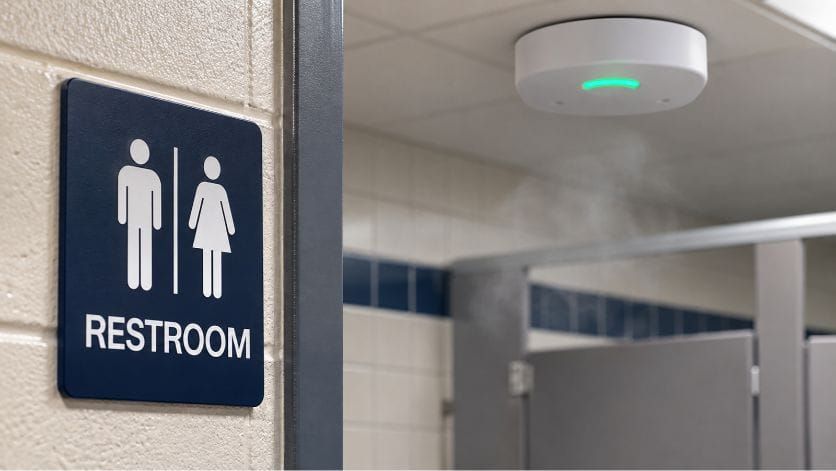
Student vaping in school restrooms continues to present challenges for administrators and school safety teams. While vape detection devices offer one potential way to identify activity, school safety leaders report varying experiences with their reliability, installation, and day-to-day use.
A recent discussion among members of the National Council of School Safety Directors (NCSSD) began when a school safety professional reported an increase in students vaping in campus restrooms. The school was already addressing the issue through student education, supervision, and disciplinary measures when appropriate, but was exploring additional strategies.
The member asked colleagues about their experiences with vape detection devices, including manufacturers, installation and maintenance challenges, false alerts, privacy considerations, and strategies beyond technology.
Members described using systems from Verkada, HALO, and Triton, with mixed results. Their experiences highlighted the importance of evaluating technology against each school's specific needs, available resources, and ability to respond to alerts. They also demonstrated that schools can have very different experiences even after investing in detection systems.
School Leaders Report Mixed Experiences With Vape Detectors
Solveig Jurmu, director of safety and security for North Shore School District 112 in Illinois, said her district uses Verkada vape detectors in middle school restrooms and locker rooms.
"They work," Jurmu wrote, adding that the district initially experienced false alarms but that those issues appear to have been resolved.
Another NCSSD member reported that their district installed Verkada vape sensors in middle and high school restrooms but experienced false alerts caused by chemicals in certain custodial cleaning products. The district continues to adjust sensor sensitivity settings to reduce false notifications while maintaining detection capabilities.
Other members shared experiences with HALO Smart Sensors. One reported that their school uses HALO sensors in restrooms to notify designated staff when possible vaping is detected. The system can also send tamper alerts if someone interferes with a device.
Not every member reported success with detection technology. One NCSSD member said their school tried vape sensors but experienced frequent false alerts and delays between vaping activity, sensor activation, and staff response.
"Here is what you don't want — responding to a bathroom and taking a student to the office because they are in the restroom at the time you arrive (the person smoking left already)," the member wrote.
Installation, Placement, and Sensitivity Settings
Jeffrey Harmon, another NCSSD member, shared lessons from his school's installation of Triton Smart Sensors before the start of the school year.
Harmon said the sensors were designed to cover spaces measuring approximately 12 feet by 12 feet, but some of the school's restrooms exceeded that area. As a result, alerts took longer to arrive because vapor needed time to reach the sensors.
The installer originally positioned sensors near restroom entrances, which generated relatively few alerts. After the devices were relocated above restroom stalls, the number of alerts increased. Harmon also said some sensors required sensitivity adjustments after installation.
Harmon also reported that his school had received more than 200 vape alerts, of which only one had been confirmed as a false alert.
He recommended enabling LED lights or audible alerts, when available, as a potential deterrent. His school initially left those features disabled before deciding to turn them on.
Harmon said the school initially received notifications early in the morning and at the end of the day, when limited administrative staff were available to respond. The school subsequently adjusted its alert schedule to align with staff availability.
Students Attempt to Circumvent Vape Detection Systems
Several members reported that students have found ways to avoid or interfere with vape detectors.
One NCSSD member said their district uses HALO sensors and reported that a YouTube video shows students how to circumvent the devices. The member said students have changed how or where they exhale vapor to avoid triggering alerts. The member reported some success concealing sensors in ventilation areas of private restrooms.
Laurie Elkins, a school safety advocate, described encountering HALO sensors that students had obstructed with wet toilet tissue placed inside the vents.
Restroom Supervision and the Role of Detection Data
Beyond installation and technical performance, members discussed how schools use the information generated by vape detectors.
Harmon said some administrators initially attempted to respond to every sensor notification but found the workload difficult to sustain. He recommended using alert data to identify restrooms and times of day associated with frequent notifications, then positioning staff near those locations.
"The best usage of the sensors is to get the data from the sensors and then target the restrooms and times of day that alerts are being received," Harmon wrote.
Another NCSSD member recommended consistent restroom checks and examining restroom entrances using crime prevention through environmental design (CPTED) principles. Depending on the layout, the member suggested considering open or indirect entrances, similar to those found in stadiums and airports, while preserving student privacy. Such designs, the member said, could help staff monitor activity and enter restrooms more quickly.
Investigating Alerts and Protecting Privacy
Members also addressed how schools can investigate vape alerts while considering student privacy. Elkins suggested connecting sensor alerts with cameras positioned outside restrooms so staff could review footage associated with notifications and identify students entering or exiting around the time of an alert.
Harmon also addressed privacy considerations associated with his school's Triton installation. He reported that the sensors did not record audio or actively listen to conversations.
What Schools Should Consider Before Investing in Vape Detection Technology
For schools evaluating vape detection technology, members' experiences raise several considerations:
- School-specific needs: Which restrooms or campus locations are experiencing the most incidents, and what existing strategies are in place?
- Installation and configuration: Are sensors suited to the size and layout of the spaces where they will be installed?
- Reliability: What factors could cause false alerts, delayed notifications, or missed incidents?
- Maintenance: How will the school address tampering, sensitivity adjustments, and ongoing equipment needs?
- Staff capacity: Who will receive alerts, and how will the school manage notifications during periods with limited supervision?
- Privacy: What information do the devices collect, and how will the school use alerts or related video footage when investigating incidents?
- Other priorities: How does the proposed investment compare with other school safety, supervision, and student support needs?