
How Well Do Your School Safety Systems Reduce Harm?
An engineer shares five steps district leaders can use to evaluate how equipment, procedures, and staff responsibilities work together to reduce harm.
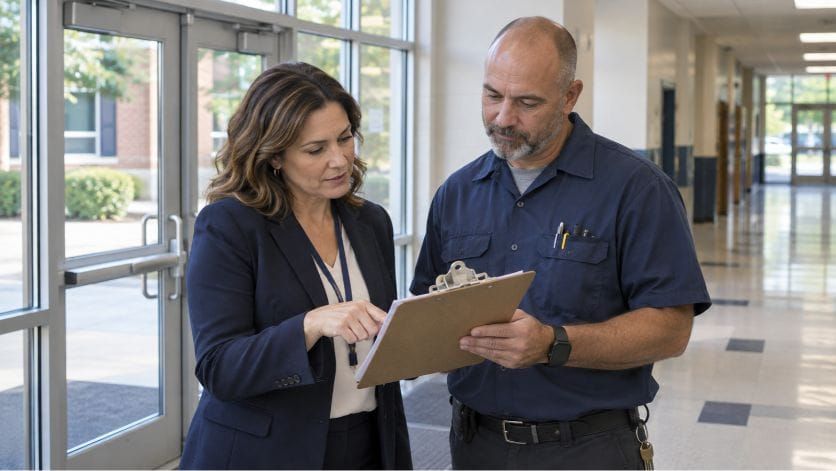
School safety leaders face a demanding responsibility: protecting students and staff when threats unfold rapidly and under conditions unlike normal school operations. Districts invest in cameras, access controls, communications, reinforced doors, school resource officers, and training. Yet a safeguard can appear effective during routine operations and fail when it matters most.
The essential question is not whether a school possesses recommended security measures. It is whether those measures work together to prevent injury under realistic conditions—and whether protection remains when one measure fails.
Prevention Must Remain the Goal
School safety must begin with a fundamental principle: Harm is preventable, and preventing it must remain the objective at every stage of a potential attack. A missed warning, an undisrupted plot, or a defeated entry barrier does not make injury inevitable. Each is a point in a sequence where another safeguard may interrupt danger before anyone is hurt.
Preventing harm and minimizing casualties are not interchangeable. Reducing casualties remains essential when earlier protections fail, but it must never replace preventing harm as the ultimate measure of school safety. Prevention sets a more demanding standard: identify how harm could occur, interrupt the pathway to injury, and verify that protective measures can accomplish their assigned functions.
This does not promise zero risk. It gives school leaders a clearer objective for design, assessment, and investment.
What Real-World Failures Reveal
Critiques of active-shooter incidents at Parkland, Uvalde, Nashville, Covenant and Westside exposed critical vulnerabilities in surveillance, fire alarms, door security, emergency access, and communications, and response procedures that must be addressed in future designs. These incidents exposed vulnerabilities that equipment inventories alone could not reveal.
- Surveillance under stress. At Parkland, smoke and ceiling dust interfered with motion-activated video recording in parts of the building. A camera may produce excellent images on an ordinary day yet provide incomplete information during an attack. Leaders should distinguish between cameras intended to preserve evidence and systems expected to deliver continuous, actionable awareness. Those are different performance requirements.
- Conflicting emergency signals. During both the Parkland and Nashville shootings, gunfire triggered false fire-alarm activation contributed to students entering hallways during the attack. In the Westside Middle School shooting, the alarm was intentionally triggered by the shooter. Fire evacuation and active-assailant responses address different hazards, but both may be triggered during one emergency. Schools must examine how alarms, instructions, and occupant actions interact, in coordination with fire officials and responders, without compromising fire-code requirements.
- Doors and emergency access. Parkland also demonstrated an unintended consequence of classroom security measures. Doors automatically locked to the outside when closed, preventing students caught in the hallways from reentering classrooms for shelter. Uvalde investigations documented door-security problems and difficulties obtaining access during the response. A door must help resist unauthorized entry while also supporting safe egress and timely authorized access. A policy saying keys will be available is not the same as demonstrating that access works under pressure.
- Communications that do not reach everyone. Intercoms, radios, and alert platforms can leave gaps in stairwells, portable classrooms, noisy spaces, or areas with weak coverage. Sending a warning does not prove people received, understood, and could act on it in time.
These examples do not show that technology is unhelpful. They show why the intended safety function, operating conditions, and interactions with other safeguards must be defined before declaring a system effective.
What Engineering Adds to the Discussion
My work in engineering and safety-critical systems has taught me to ask two questions about any safeguard. What does it need to do, and how can we tell whether it works under the conditions it was designed for?
In one laboratory, a glovebox and its ventilation system appeared to be installed correctly. A smoke test revealed small leaks in the ductwork that kept the system from reliably capturing hazardous fumes under certain conditions. A visual inspection had missed the leaks.
School leaders can apply the same approach by considering realistic scenarios, identifying where protection could fail, and defining what each safeguard needs to accomplish. They can then test whether it performs as intended.
The Need for a Structured School Safety Framework
School leaders face an expanding array of security measures, technologies, procedures, and recommendations. Yet a safeguard can appear useful, provide reassurance, and still fail to address the most consequential vulnerability at a particular school. This is one reason school safety planning can become overwhelming. The problem is often not a lack of concern, effort, or investment, but the absence of a structured process for determining which measures will actually improve safety-system performance and reduce the risk of injury.
Every school operates under different conditions and will require a different combination of safeguards. What should remain consistent is the framework used to establish and evaluate them. Such a framework must begin by identifying credible pathways to harm, defining the safety functions needed to interrupt those pathways, and selecting safeguards capable of performing those functions. It must also account for human behavior, operational conditions, and interactions among protective measures.
Most importantly, the framework must require verification that safeguards perform as intended under realistic conditions, before an emergency puts them to the test. The objective is not simply to implement more security measures, but to establish a coherent safety system whose ability to prevent harm can be demonstrated.
5 Practical Steps for District Leaders
- Start with a credible scenario, not a solution. With administrators, teachers, facilities staff, security personnel, and local responders, examine credible situations such as unauthorized entry during arrival or a threat near occupied classrooms. Identify who might be exposed, how conditions could worsen, and where protection could interrupt the sequence. Keep sensitive vulnerability findings controlled.
- State what each safeguard must do. Rather than recording only “camera installed” or “door secured,” define the outcome: detect an unauthorized entry promptly, communicate an understandable warning, delay access to an occupied space, or enable authorized emergency entry. Specify who must receive the information and act and how quickly, where practical.
- Test actual performance safely. Verify door latching during normal transitions, radio and intercom coverage across occupied areas, emergency message intelligibility, and backup capabilities when a primary system is unavailable. Use controlled, age-appropriate exercises coordinated with responders; do not create dangerous conditions or unnecessary student distress. Record failures and retest after correction.
- Evaluate the whole system, including people. Cameras rely on monitoring and communication. Access controls depend on maintenance and everyday staff behavior. Emergency procedures may conflict. Ask what happens if equipment fails, a warning is delayed, or someone makes a mistake. Layers should provide additional chances to prevent harm, not merely duplicate the same weakness.
- Prioritize and verify improvements. Rank gaps by potential consequences, exposure, reliability of existing protection, and feasibility of correction. Some issues require immediate maintenance or procedural changes; others need capital planning. Assign an owner and deadline to each action, then verify that the change fixes the identified problem. Avoid purchasing technology simply because it is popular or highly featured.
Make Evaluation Continuous
School conditions change: equipment ages, buildings are modified, staff turn over, and routines drift. Reassess safeguards after significant changes and through scheduled inspections, exercises, and corrective-action reviews.
Pay particular attention to workarounds. Repeatedly propped doors, bypassed visitor procedures, or unused radios may signal that safeguards conflict with operational reality. Training matters, but leaders should also ask whether the design or procedure needs improvement.
A reliable school safety system does not assume perfect people or flawless equipment. It anticipates errors, maintains overlapping protective opportunities, and checks whether the combined system still works.
The Leadership Test
Every campus will require a different mix of measures. What should remain consistent is the method used to select and evaluate them. Leaders should be able to explain why each important safeguard exists, what it must accomplish, how it works with other protections, and what evidence shows it remains effective.
The question to carry into the next budget meeting, assessment, or drill is simple: Have we demonstrated that our safeguards can interrupt the pathway to harm before students or staff are injured?
That is the difference between accumulating security measures and building a prevention-focused safety system.
References
Marjory Stoneman Douglas High School Public Safety Commission, Initial Report Submitted to the Governor, Speaker of the House of Representatives and Senate President (Florida Department of Law Enforcement, 2019), http://fdle.state.fl.us/home/showpublisheddocument/11008/639250373155600000
The Covenant Presbyterian Church and School Shooting, Nashville, TN (March 31, 2025), https://www.nashville.gov/sites/default/files/2025-04/Covenant_Final_Summary.pdf.
“Westside School Shooting,” Encyclopedia of Arkansas, last updated December 11, 2025, https://encyclopediaofarkansas.net/entries/westside-school-shooting-3717/.
Critical Incident Review: Active Shooter at Robb Elementary School (U.S. Department of Justice, 2024), https://portal.cops.usdoj.gov/resourcecenter/content.ashx/cops-r1141-pub.pdf.
This article was contributed by John Menna, PhD, a safety engineering with 35+ years in DOE high-hazard operations and founder of Principled Safety LLC.
Note: The views expressed by guest contributors are those of the authors and do not necessarily represent the views of, and should not be attributed to, School Security Leadership.