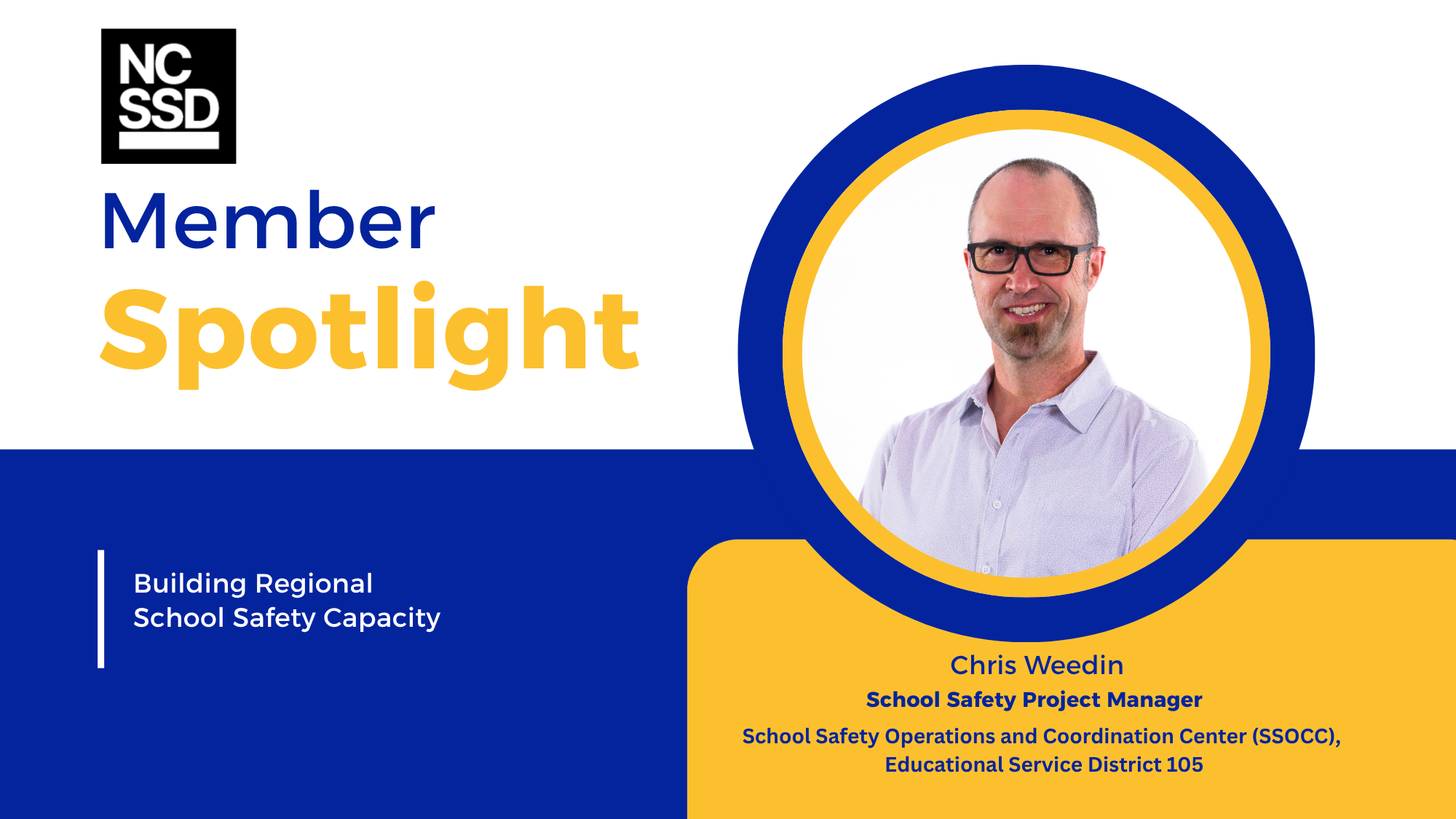
Chris Weedin: Building Regional School Safety Capacity
School Safety Project Manager Chris Weedin discusses the importance of collaboration, innovative training, and empowering schools to take ownership of their safety efforts.

Editor’s Note: Our Member Spotlight series highlights NCSSD members and the important work they do to support safe and secure schools.
NCSSD Member Spotlight
Chris Weedin
School Safety Project Manager
Organization: School Safety Operations and Coordination Center (SSOCC), Educational Service District 105
Years in School Safety: 10
About Chris
For this Member Spotlight, we spoke with Chris Weedin, School Safety Project Manager for the School Safety Operations and Coordination Center (SSOCC) in South Central Washington State.
Chris has spent the past decade helping schools strengthen their safety and security programs through training, planning, assessments, exercises, and consultation. He also serves as a Fusion Liaison Officer with the Washington State Fusion Center and works closely with schools across the region on preparedness, threat assessment, and emergency management initiatives.
We asked Chris about his path into school safety leadership, the work he's most proud of, and why collaboration remains one of the profession's most important priorities.
Q: What led you to school safety leadership, and what motivates your work today?
"I have been involved in safety and security for years in various fashions," Chris said. "What brought me into leadership was need."
Following several high-profile tragedies, schools throughout his region began looking for a more coordinated approach to safety and security.
"We saw the need and stepped into the role, creating Washington State's first and largest School Safety Operations and Coordination Center," he said. "I thank God for putting me in the right place at the right time to help make a difference."
Q: What accomplishment are you most proud of?
Chris is particularly proud of helping create the School Safety Operations and Coordination Center (SSOCC), Washington State's first and largest regional school safety center.
"We started this program without a model or formal guidance in a time when school safety was in its infancy," he said.
What began as a regional effort has since grown into a program that now supports more than 100 schools across more than 25 public and private districts.
Chris is also proud of his involvement in launching a statewide school safety staff training initiative and helping implement HearMeWA, Washington's anonymous youth safety tip line.
Q: What are your top priorities right now?
Chris's focus is helping schools build the confidence and capability to take ownership of their safety efforts.
"Finding new and innovative ways to engage and empower schools so that they can take control of their own safety," he said.
Through innovative training, progressive drills, and student engagement initiatives, Chris and his team work to help schools strengthen their safety programs and build lasting safety cultures.
"We seek to kindle a sense of urgency around safety and security and the skills to see that it is constantly improving."
Related Reading
Learn how school safety leaders are designing drills that build preparedness without increasing fear.
Preparedness Without Fear: What Effective School Safety Drills Look Like →
Q: What resources have had the biggest impact on your work?
Chris points to professional communities and accessible training opportunities as some of the most valuable resources available to school safety leaders.
"Groups like the NCSSD and ZeroNow are key to advancing my work and school safety in general," he said. "Low or no cost, high quality training and certifications like FoSSL are instrumental in advancing our work."
Q: Why did you join NCSSD?
When asked about the value of NCSSD membership, Chris highlighted the community's openness, expertise, and willingness to share.
"The NCSSD is a plain and simple, open and honest, no holds barred clubhouse for school safety and security nerds," he said. "The transparency and simplicity are refreshing, the depth of knowledge humbling and the ability to interact and grow with fellow safety practitioners invaluable. I love this group."
Q: What future initiatives are you focused on?
Looking ahead, Chris and his team are focused on developing comprehensive guidance around progressive drills, exercises, and reunification practices.
He hopes those efforts will help schools build confidence and consistency in some of the most challenging areas of emergency preparedness.
Q: Any final thoughts for fellow NCSSD members?
For Chris, one of the biggest challenges facing the profession is the persistence of silos between disciplines, agencies, and stakeholders.
"Organizations like NCSSD are leading the way in breaking down the barriers that keep us from our best protective work for schools," he said. "We all need to take note, root out such behavior and take the lead in modeling true collaboration. That's how we'll make safer schools."
Know an NCSSD Member Making a Difference?
We're always looking to highlight school safety professionals from across the country. If you'd like to be featured or nominate a fellow NCSSD member, contact editor@ncssd.org.