K-12 Student-to-School-Counselor Ratio: Where Does Your State Fall?
School counselor shortages continue to challenge K-12 schools, but new funding initiatives and alternative certification programs are helping close the gap.


Editor's Note: This article, originally published on May 14, 2026, was last updated on July 22, 2026, to reflect new data.
School counselors play an integral role in students’ lives. They provide academic and social-emotional support, crisis intervention, and college and career planning, often tailoring their programs to meet their schools’ unique needs.
Although the American School Counselor Association (ASCA) recommends one counselor for every 250 students, data from the 2024-2025 academic year shows only four states met that benchmark. Additional data from the U.S. Department of Education also shows 17% of high schools do not have a school counselor at all.
While these findings are concerning, the student-to-school-counselor ratio has steadily improved over the last 12 years. During the 2021-2022 academic year, the national average was 408:1. That number improved to 385:1 the following year, then to 376:1 the year after.
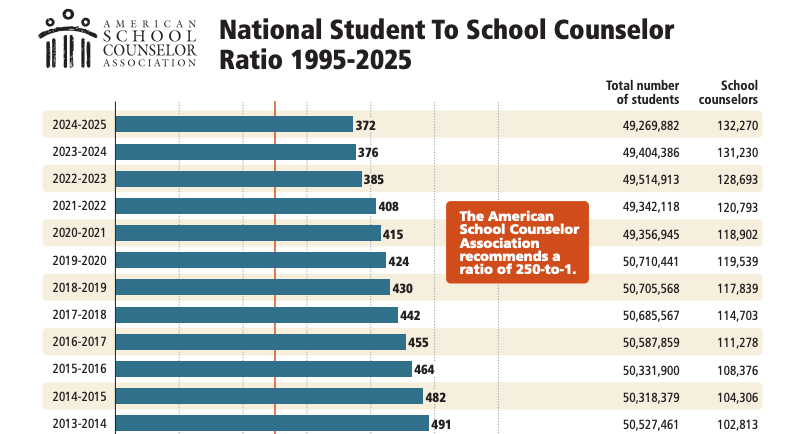
However, U.S. public schools remain far from the recommended ratio, with a national average of 372:1 last year. Only four states currently meet the recommended benchmark, while states such as Arizona, Michigan, Minnesota, and Utah report some of the nation’s highest student caseloads.
Here is the breakdown by state:
States That Meet the Recommended Student-to-School-Counselor Ratio
- Colorado – 247:1
- Hawaii – 243:1
- New Hampshire – 186:1
- Vermont – 172:1
States That Don't Meet the Recommended Student-to-School-Counselor Ratio
- Alabama – 401:1
- Alaska – 414:1
- Arizona – 570:1
- Arkansas – 353:1
- California – 432:1
- Connecticut – 313:1
- Delaware – 320:1
- District of Columbia – 270:1
- Florida – 425:1
- Georgia – 386:1
- Idaho – 395:1
- Illinois – 486:1
- Indiana – 479:1
- Iowa – 340:1
- Kansas – 411:1
- Kentucky – 322:1
- Louisiana – 423:1
- Maine – 285:1
- Maryland – 309:1
- Massachusetts – 341:1
- Michigan – 565:1
- Minnesota – 539:1
- Mississippi – 367:1
- Missouri – 293:1
- Montana – 288:1
- Nebraska – 331:1
- Nevada – 437:1
- New Jersey – 290:1
- New Mexico – 406:1
- New York – 305:1
- North Carolina – 360:1
- North Dakota – 282:1
- Ohio – 380:1
- Oklahoma – 356:1
- Oregon – 321:1
- Pennsylvania – 317:1
- Rhode Island – 391:1
- South Carolina – 307:1
- South Dakota – 336:1
- Tennessee – 429:1
- Texas – 397:1
- Utah – 468:1
- Virginia – 279:1
- Washington – 364:1
- West Virginia – 309:1
- Wisconsin – 362:1
- Wyoming – 287:1
What Is Driving the School Counselor Shortage?
The U.S. Department of Education estimates there are 4,000 vacant school counselor positions nationwide.
According to ASCA, key factors contributing to the school counselor shortage include:
- Burnout and the ongoing student mental health crisis
- High caseloads and mismatched job responsibilities
- Funding shortages and budget cuts
- Significant certification barriers
How Are States Improving Student-to-School-Counselor Ratios?
Despite the aforementioned challenges, states and institutions are working diligently to find solutions.
In most states, school counselors are required to obtain a master's degree, which can create financial and logistical barriers for those interested in the profession. ASCA Executive Director Jill Cook told NEA Today that many organizations are now exploring more flexible certification models to expand the pipeline while maintaining high standards.
One example is Northern Illinois University's School Counselor Institute (SCI), which allows licensed clinical mental health counselors to earn their Illinois Professional Educator Licenses and School Counseling endorsements without pursuing a second master's degree, according to NIU Today.
Students complete the program within one calendar year through online, primarily asynchronous coursework paired with an internship. The 20th cohort graduated this spring.
“Our skills in being a clinical mental health counselor and being a school counselor are somewhat similar. We use our facilitative responses and foundational counseling skills. We have a theory that guides us,” TJ Schoonover, SCI coordinator and assistant professor in the Department of Counseling and Higher Education, told NIU Today. “But what school counselors do–their day-to-day–is so much different. They follow the American School Counseling Association National Model, which provides the structure to create a comprehensive school counseling plan.”
Minnesota is also working to strengthen its pathway into the profession. Earlier this year, the Minnesota Department of Education gave St. Cloud State University a $370,000 Pipeline Grant, which provides up to $400 per credit in tuition assistance for current and prospective school counseling graduate students, KNSI Radio reports.
“Minnesota has had a gap in underrepresented counselors of color for many years; the state has recognized that, and this grant is one way to address that gap,” said Dr. Bill Lepkowski, director of SCSU’s school counseling graduate program. “In addition, we generally don’t have enough school counselors, and there’s an increasing awareness of mental health for kids to be successful.”
Students interested in learning more about the program can fill out this form.
Pennsylvania has focused on broader mental health investments. Through Act 55, the state committed $100 million to student mental health initiatives, with $95 million supporting hiring, training, partnerships, and telehealth services, according to Urban.org.
Pennsylvania school districts each received grants of $100,000 plus $15 per student. Charters, intermediate units, and career technical centers also received $70,000 each.
Prior to receiving the grant, approximately 20% of Pennsylvania elementary schools and one in six secondary schools had no counselors at all. Across all schools, only 17% had a social worker and around 45% had a school psychologist. The passing of Act 55 allowed 583 schools across 287 districts to increase existing full-time equivalent mental health staff or to add positions. On average, ratios dropped by 377 students for elementary school counselors and by 150 students for secondary school counselors.
While expanding the school counseling workforce remains a priority, many schools continue to face another challenge: connecting students with behavioral health services once a need has been identified. As a result, states are increasingly investing in partnerships between schools and community providers to help close that gap.
States Are Also Expanding School-Based Mental Health Partnerships
Even when schools identify students who need support, connecting them with behavioral health services can be difficult in many communities because of workforce shortages beyond the school walls.
North Carolina has become one example of why those partnerships matter. Following the deaths of eight current or recently graduated students from Myers Park High School in Charlotte by suicide between late 2021 and late 2025, the tragedies prompted broader conversations about adolescent mental health, timely intervention, and stronger coordination among schools, families, and behavioral health providers.
The conversations come at a time when more than one-third of North Carolina high school students report feeling persistently sad or hopeless. At the same time, 94 of the state's 100 counties have shortages of mental health professionals, and 43 counties have no child psychiatrist. Those workforce shortages can make timely access to care difficult even after schools identify a student who needs support.
To help address those challenges, North Carolina has expanded school-community behavioral health partnerships designed to connect students with services more quickly. One example is Alliance Health's school-based model in Wake County, which served more than 600 students in a single school year, News From The States reports. Among students experiencing a behavioral health crisis, 93% were successfully connected to needed treatment, and every student returning from psychiatric residential treatment successfully transitioned back to school with coordinated support. The initiative has since expanded into Durham County.
Meeting Students' Growing Mental Health Needs
School counselors remain critical to student success and well-being. Research shows comprehensive counseling programs are associated with higher graduation rates, improved test scores, better attendance, and fewer suspensions.
While counselor shortages remain a significant challenge, states are increasingly recognizing that improving student mental health requires more than hiring additional counselors alone. Investments in certification pathways, financial support, and stronger partnerships between schools and community behavioral health providers are helping create more comprehensive systems of care for students.
Additional ASCA Resources
- The Role of the School Counselor
- ASCA Student Standards: Mindsets & Behaviors for Student Success
- The ASCA National Model®: A Framework for School Counseling Programs
Share Your Input
How is your school/district working to improve school counselor staffing, support, or access to mental health services?
We’d like to hear about what strategies, programs, or funding solutions are making a difference in your schools.