AI-Powered School Security Cameras: Benefits, Risks, and What School Leaders Should Know
An industry expert discusses the benefits and risks of AI-powered school security cameras, including cybersecurity, NDAA compliance, privacy, and aging equipment.

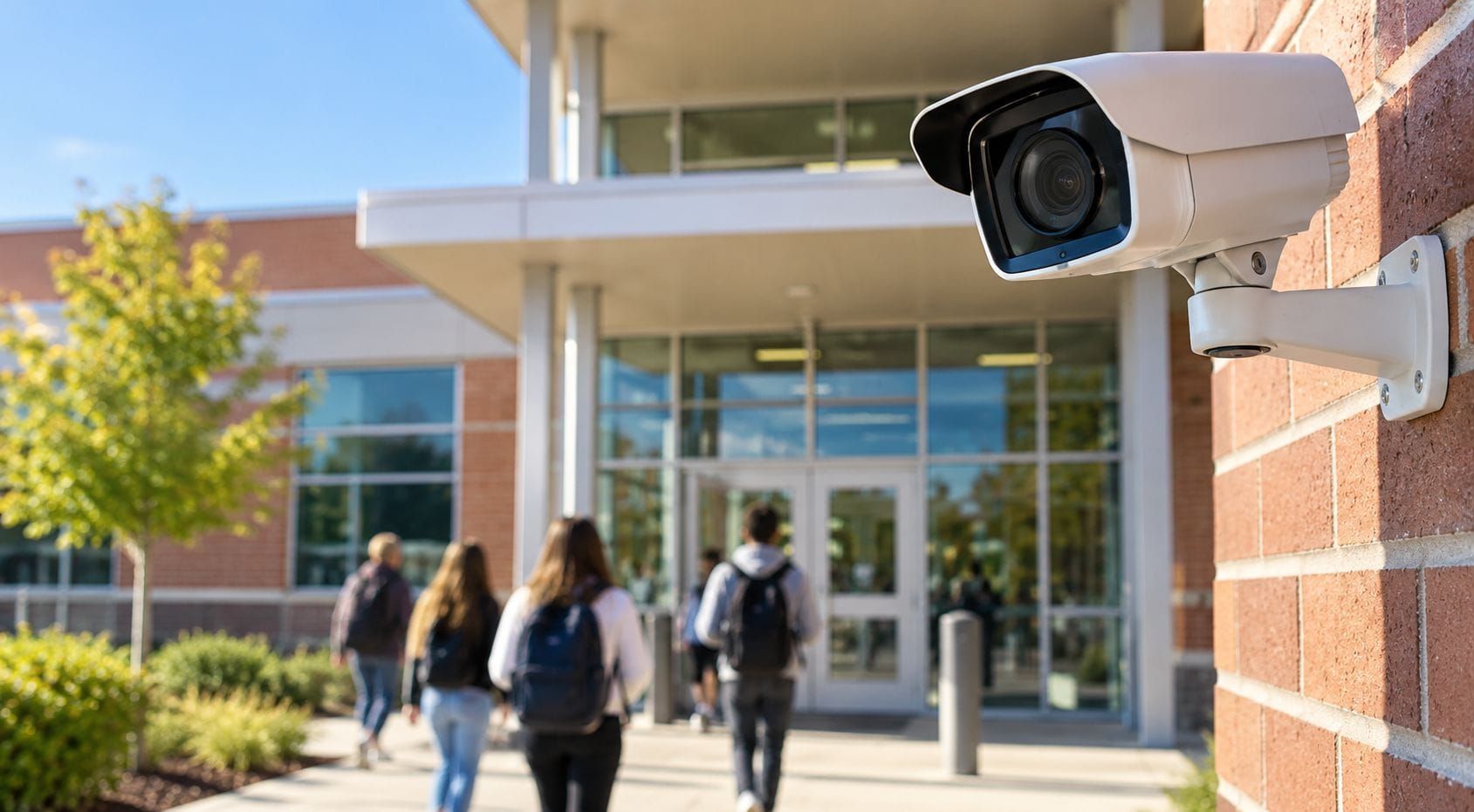
Security cameras are already common in K-12 schools, but advances in artificial intelligence (AI) are changing how districts can use them. Rather than relying on footage primarily to investigate incidents after they occur, AI-powered video analytics can help security teams identify potential concerns in real time. However, taking advantage of these capabilities may require districts to reassess their existing camera systems, cybersecurity protections, and surveillance policies.
School Security Leadership spoke with Paul DuBois, an education security expert at Hanwha Vision, about how AI is changing school video surveillance, the risks associated with outdated or non-NDAA-compliant equipment, and what school safety leaders should consider when planning upgrades.
The Q&A has been slightly edited for clarity and length.
Q&A with Hanwha Vision
How is AI changing the role of school security cameras, and what are its limitations?
Traditionally, schools often turned to video after something happened. AI-powered analytics increasingly allow security teams to identify situations that may require attention in real time. Instead of expecting personnel to continuously watch dozens of camera feeds, analytics can surface relevant activity and alert staff so they can assess what's happening and determine the appropriate response.
AI should be viewed as a tool that supports security personnel, not a replacement for human judgment. An alert still needs context, and districts need clear policies around how analytics are used, who receives that information, and what happens next. Thoughtful implementation is just as important as the technology itself.
Why should districts prioritize modernizing their existing video surveillance systems?
Security technology is advancing quickly, and today's cameras can do far more than simply record footage. With each generation, image quality improves and cameras can cover greater distances.
Modern video systems can also help schools manage congested student arrivals and departures, monitor gyms and theaters during large events, and protect outdoor athletic fields and parking lots. For districts relying on older cameras, modernization is increasingly about getting more operational and security value from infrastructure they already depend on every day.
What risks do outdated or non-NDAA-compliant security cameras pose to schools?
Non-NDAA-compliant devices remain prevalent in educational environments and can pose significant cybersecurity risks. Every connected device needs to be considered as part of a district's broader cybersecurity posture, because a vulnerable device can potentially create another entry point into the network.
Districts also need to look beyond the manufacturer's name when assessing existing equipment. A manufacturer may offer NDAA-compliant products today, but that doesn't necessarily mean every older model already installed on campus meets current requirements. That makes a detailed inventory of existing devices, including specific models and their support status, an important part of any modernization effort.
How can districts identify gaps in camera coverage and determine where surveillance is most needed?
We and our partners work closely with school districts to identify their most significant challenges and areas of concern that may have received less attention. I always recommend starting with a district-wide security assessment conducted by a trained professional. Rather than simply adding cameras where incidents have already occurred, an assessment can identify broader vulnerabilities, determine where existing coverage is working well, and uncover areas that may have received less attention.
Some of the areas we commonly see under-monitored are campus perimeters, outdoor athletic fields, playgrounds, and facilities buildings that house landscaping equipment, custodial supplies, or other valuable assets. This is especially important for districts with limited security personnel. When cameras are deployed strategically, video can serve as a force multiplier by helping a smaller team maintain awareness across a much larger campus.
RELATED RESOURCE
Video Surveillance in Schools Topic HubExplore articles and resources on school video surveillance, including camera technology, privacy, data security, and considerations for school safety leaders.
How important is it for video surveillance to integrate with other school security systems?
Districts need solutions that are easy to use and administer, address real challenges, and keep security teams from having to switch between disconnected systems during an incident. Having a single interface where users can access the information they need can be beneficial.
At the same time, districts shouldn't consolidate systems simply to rely on one vendor. A platform may offer many capabilities without necessarily being the strongest solution for every need. That's why I encourage districts to prioritize open, non-proprietary technologies that can integrate with other systems and evolve. Schools make significant investments in security infrastructure, and replacing otherwise functional equipment because a new system isn't compatible can be costly.
Where should schools draw the line between AI-powered surveillance and student privacy?
Balancing security with privacy is one of the most important considerations for any school district deploying video technology, and the expansion of AI makes having clear policies even more important. Districts should define what they're trying to accomplish with the technology, what information is actually necessary to do so, who can access that information, and how it will be handled.
I recommend deploying systems that support both fixed and dynamic privacy masking. Fixed privacy masking, for example, can address sensitive areas and items like an administrator’s computer monitor, while dynamic privacy masking can obscure individuals moving within a scene. Ultimately, having the technical capability to collect or analyze something doesn't automatically mean a school needs to use it. The technology should follow the district's security objectives, privacy policies, and community expectations.
What can schools learn from recent concerns about license plate recognition technology and surveillance data?
License plate recognition can be an extremely useful security tool when it's deployed for a clearly defined purpose and the data it generates is appropriately protected. The larger lesson for districts is that access to sensitive surveillance data shouldn't automatically be granted simply because someone has permission to view cameras. Districts should establish role-based access so that only authorized personnel can access LPR data and other sensitive information. They should also maintain and routinely review audit logs so they know who is accessing the system and can identify unauthorized access attempts or unusual activity.
Those same principles should extend to AI-powered video more broadly: understand what data you're collecting, why you're collecting it, who can access it, and how that access is being monitored.
RELATED RESOURCE
ALPRs in Schools: What K-12 Leaders Should Consider Before AdoptionExplore key considerations for schools evaluating license plate recognition technology, including privacy, data security, and oversight.
What cybersecurity and data protection questions should districts ask security technology vendors?
Cybersecurity and data protection should be part of the vendor-selection process from the beginning, not something a district investigates after a system has been purchased. I recommend requiring FIPS 140-3-validated cryptographic modules when evaluating security products and asking how vendors handle vulnerabilities and software updates throughout the product’s life.
Districts should also ask very practical questions about their data:
- Where is it stored?
- How is it protected?
- Who can access it?
- Can third parties access it, and under what circumstances?
- How quickly is video available when the district needs it?
District data should be accessible only to authorized district personnel and explicitly approved third parties. Those expectations should be clear before deployment rather than discovered after the fact.
How should districts prioritize camera upgrades, and what funding options are available?
Most districts can’t modernize everything at once, so prioritization should start with a current security assessment that identifies the greatest risks and gaps. That gives schools a clear roadmap for addressing outdated or noncompliant equipment. Grant funding can help accelerate those upgrades, but districts should prepare before opportunities become available. Keeping assessments current, documenting vulnerabilities, and having a clear modernization plan can put schools in a stronger position to pursue funding when it becomes available.
Looking ahead, what should districts be preparing for next?
Districts should focus on building security infrastructure that can adapt as technology changes. That requires closer coordination between physical security, IT, and operations teams, particularly as video systems become more connected and data-driven.
Schools should prioritize open-architecture technologies that integrate with existing infrastructure, regularly review cybersecurity practices, and establish plans and budgets for replacing aging equipment. The goal isn't to adopt every new capability but to ensure districts can incorporate new technology when there's a clear security or operational need.