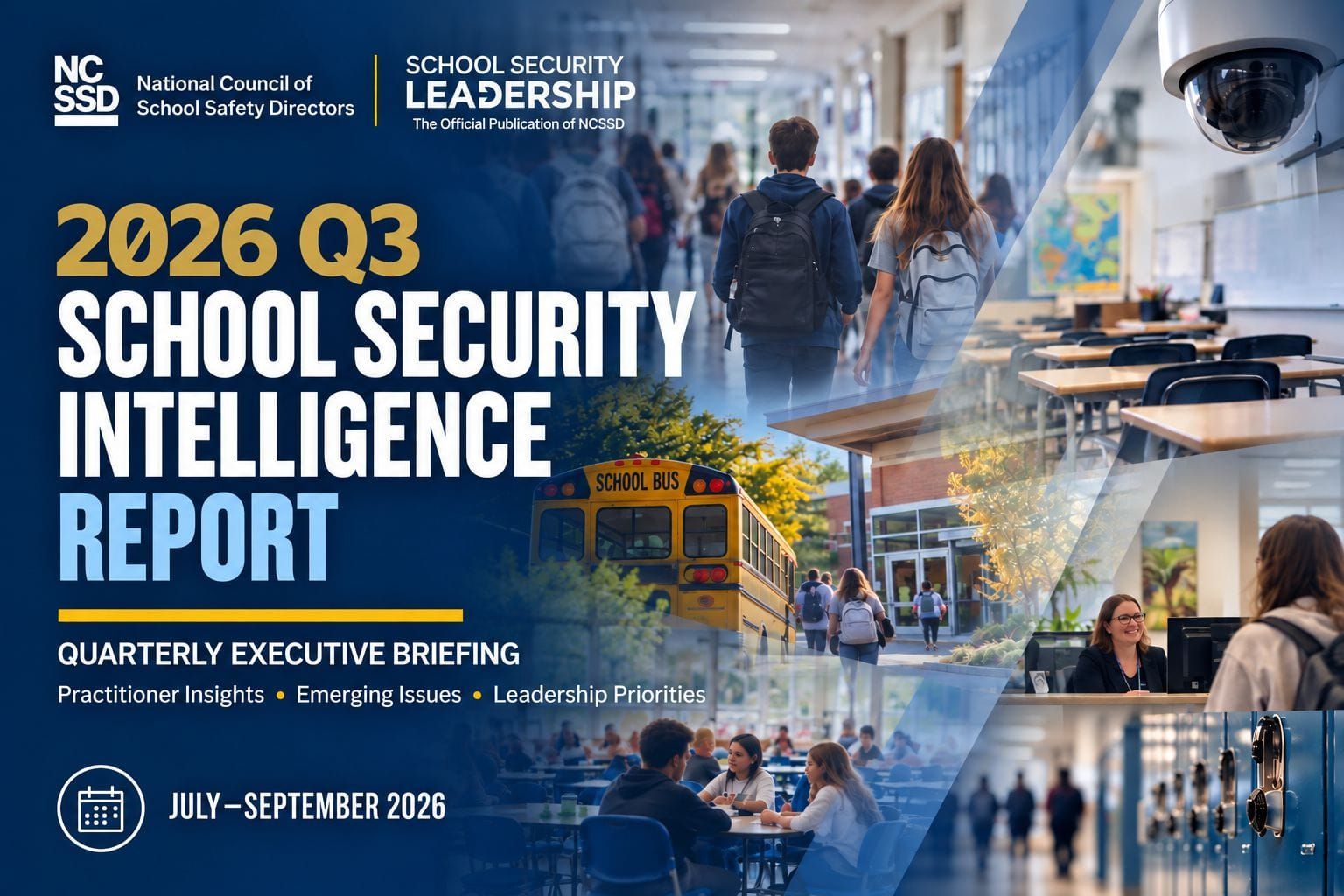
2026 Q3 School Security Intelligence Report
An executive briefing examining K-12 school safety trends, emerging technologies, policy developments, and practitioner insights from July through September 2026.

School safety leaders are navigating increasingly complex decisions about technology, policies, emergency preparedness, and emerging threats. As new tools and capabilities become available, questions about implementation, oversight, and effectiveness in everyday school operations are becoming just as important as the technologies themselves.
The Q3 2026 School Security Intelligence Report, produced by School Security Leadership, the official publication of the National Council of School Safety Directors (NCSSD), examines key developments in K-12 school safety from July through September 2026.
Drawing on NCSSD member discussions, practitioner interviews, original reporting, webinars, and research, the report highlights emerging issues, district experiences, and practical considerations for school safety leaders.
Released during America's Safe Schools Week, the report provides a timely look at recent developments and what they may mean for school safety planning.
Q3 At a Glance
During the third quarter, school safety leaders examined emerging technologies, evolving policies, and the practical implications of new approaches to school safety. The full report explores six recurring themes through key developments, practitioner perspectives, and related resources.
Video Surveillance & Governance
Expanding surveillance capabilities are raising questions about privacy, access, data sharing, and oversight, including the use of advanced analytics and automated license plate readers.
Artificial Intelligence in School Safety
Growing AI use is creating new opportunities and risks for schools, increasing the need for clear policies, careful evaluation, data protection, and human oversight.
Student Technology & Digital Safety
As schools implement cell phone restrictions, attention is shifting to enforcement, emergency access, classroom screen time, social media, and online safety concerns.
Emerging Security Technologies
Technologies such as force-capable indoor drones are prompting schools to evaluate actual safety needs, potential risks, operational challenges, and oversight before adoption.
Emergency Alerts & Critical Communications
Wider adoption of wearable panic buttons and emergency notification systems is placing greater emphasis on training, integration, false alerts, and coordinated response.
Behavioral Threat Assessment & Evolving Threats
Schools continue refining threat assessment practices, information gathering, and intervention while addressing evolving threats, including swatting and anonymous reports.
Download the Full Q3 Report
The free 16-page report covers six school safety themes, featuring practitioner perspectives, district examples, and resources to support planning and decision-making.
Stay Connected With NCSSD
The insights in this report are informed in part by the school safety professionals who share their experiences, challenges, and lessons learned through the National Council of School Safety Directors (NCSSD).
NCSSD members participate in ongoing discussions, exchange practical resources, and connect with school safety leaders across the country. Their perspectives also help inform future editions of the School Security Intelligence Report.
Join NCSSD to participate in the conversations and contribute your perspective.
Explore Previous Reports
Missed our last quarterly report? Read the 2026 Q2 School Security Intelligence Report for insights into school safety developments and leadership priorities during April–June 2026.